Refining Capacity Requirements Forecasts
(Source: OPEC`s World Oil Outlook to 2050)
Table below captures OPEC’s assessment of period-wise distillation capacity additions, in five year intervals
Between 2025 and 2050, OPEC expects total cumulative distillation capacity addition of 19.5 mb/d, comprising of 5.8 mb/d from “assessed projects” and 13.7 mb/d from “New Units”
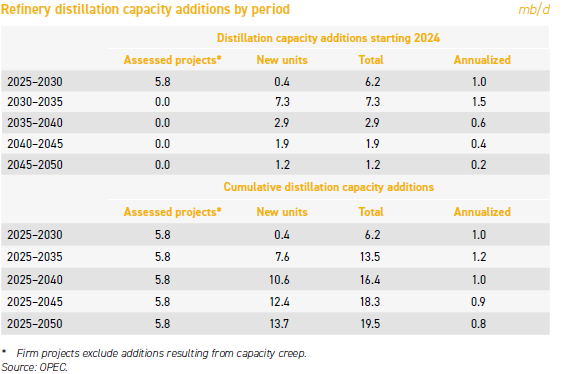
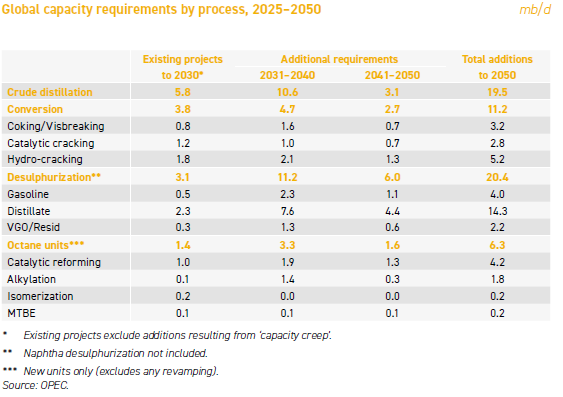
Table below captures OPEC’s assessment of global capacity requirements by process during 2025-2050 period
It expects additional conversion capacity requirement of 11.2 mb/d, comprising Coking/Visbreaking 3.2 mb/d, Catalytic cracking 2.8 mb/d and Hydro-cracking 5.2 mb/d. Hydrocracking is expected to remain the preferred upgrading option for many refiners. This is due to significant advancements in this technology, which can be tailored to adapt to different feed qualities and targeted products, as well as its ability to achieve deep conversion of bottom-barrel streams to improve yields of light products, particularly petrochemical feedstocks
It expects additional desulphurization capacity requirement of 20.4 mb/d and additional Octane enhancing capacity of 6.3 mb/d. This slightly higher than the required distillation capacity in the same period. This reflects the rising sulphur content of the average barrel, the shift to higher-quality fuels, as well as increasingly stringent environmental regulations related mostly to sulphur content in transportation fuels, especially in developing countries
OPEC expects additional requirement of around 6.3 mb/d of octane units at the global level. Octane unit additions are dominated by catalytic reforming, with almost 4.2 mb/d in the period to 2050. Catalytic reforming provides a high-octane number stream, which allows additional naphtha – including that from condensates – to be blended into the gasoline pool