
CO2 Emissions Forecasts
In the Current Policies scenario, IEA expects annual global energy-related CO2 emissions to rise from 38 gigatonnes (Gt) in 2024 to 39 Gt in the early 2030s and remain around this level to 2050, with increasing CO2 emissions from fossil fuel use in the industry and transport sectors offset by declining emissions in the power sector
In the Stated Polices scenario, IEA expects annual global energy-related CO2 emissions to peak in the next few years and fall to around 35 Gt by 2035, a level last seen in 2015. By 2050, global CO2 emissions are below 30 Gt, a level last seen in 2005. The reduction in emissions is primarily driven by changes in power generation, where the share of fossil fuels drops from around 60% today to less than 40% in 2035 and about 20% in 2050. Increased demand for renewables and further electrification of end-uses are the leading sources of emissions reductions through to 2035 and then to 2050
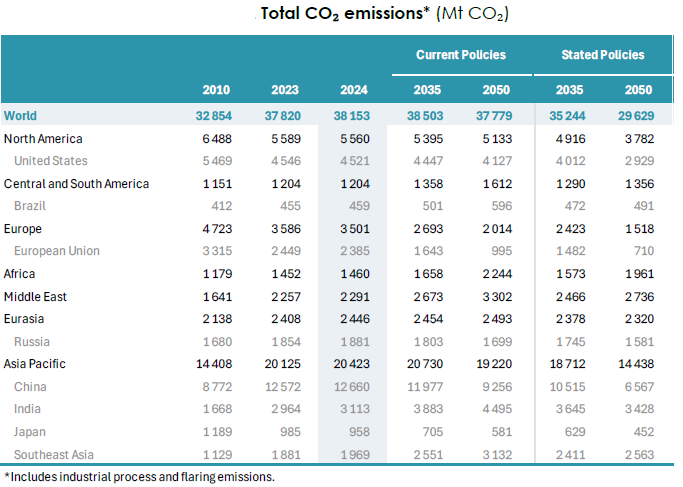
In 2024, global energy-related GHG emissions reached 42.6 gigatonnes of carbon-dioxide equivalent (Gt CO2-eq). Energy-related GHG emissions comprise Carbon dioxide (CO2), methane (CH4) and nitrous oxide (N2O) from fossil fuel combustion, flaring and fugitive CO2 and industrial processes. CO2 emissions accounted for 38.2 Gt of this total – an all-time high
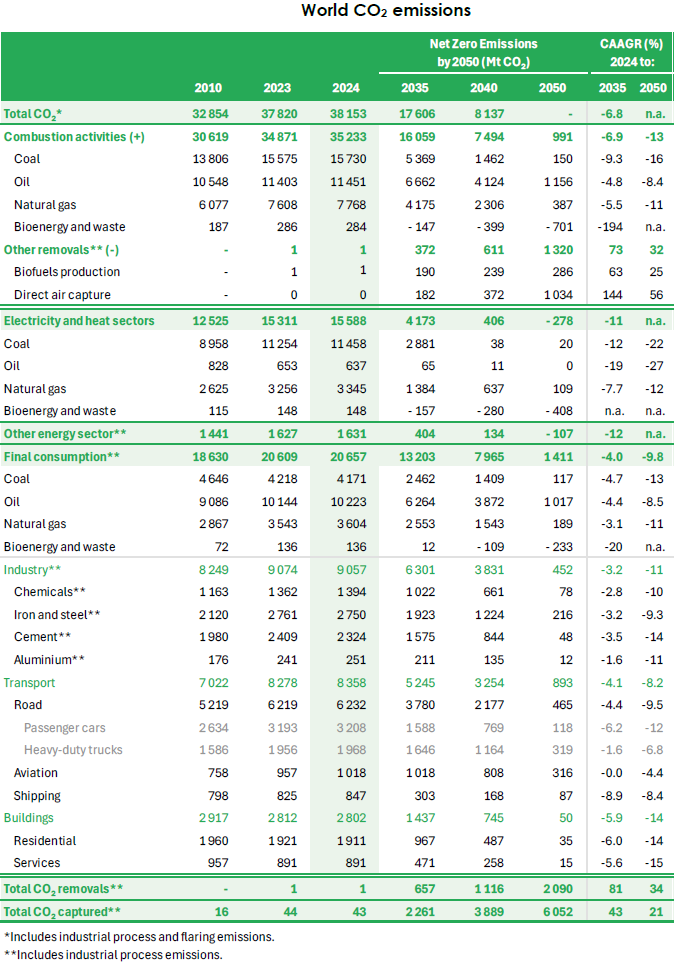
In the Net Zero Emissions (NZE) Scenario, IEA expects GHG emissions to fall around 50% to 2035, and CO2 emissions by almost 55% to around 18 Gt. Emissions from electricity generation, which today make up about 40% of total energy-related CO2 emissions, decline particularly fast: they drop to around one-quarter of today’s levels by 2035. By 2050, remaining energy-related CO2 emissions of around 2.1 Gt are mainly from industry (0.45 Gt), aviation and shipping (0.4 Gt) and road freight (0.32 Gt), and are balanced by removals of the same magnitude, without any reliance on removals from land-use measures
Reducing or limiting the growth in non-energy-related GHG emissions also plays a valuable part in minimising the rise in global temperatures. For example, in the NZE Scenario CO2 emissions associated with deforestation are expected to fall almost 50% by 2050, with the result that net CO2 emissions from land use and forestry, i.e. including the effects of afforestation, fall from over 4 Gt today to net zero in the mid-2040s. In a similar vein, efficiency gains in crop management which reduce reliance on fertiliser mean that nitrous dioxide emissions from agriculture in 2050 are expected to be close to current levels, despite a 75% increase in crop production for food and bioenergy by that time. Despite these measures, it remains hard to eliminate all non-energy related GHG emissions by 2050, particularly those from agriculture and from F-gases used as refrigerants and in industrial processes. Emissions of non-energy-related GHGs are expected to fall by 45% between 2024 and 2050