
World Low Carbon H2 Balance Forecasts
(Source: IEA World Energy Outlook 2025)
Around 100 million tonnes of hydrogen (Mt H2) were used in the energy sector in 2024, of which around 55% was in industry, mostly to produce ammonia and methanol, and around 45% was in refineries for hydrocracking and desulphurisation processes
Today, hydrogen is almost entirely produced from unabated fossil fuels, resulting in CO2 emissions of 980 Mt CO2. Low-emissions hydrogen meets less than 1% of global hydrogen demand
Low-emissions hydrogen and hydrogen-based fuels can support decarbonisation in parts of the energy sector where other mitigation measures are more difficult or costly
Table below captures IEA’s assessment of low-emissions hydrogen balance under Current Policies / Stated Polices and Net Zero Emissions scenarios
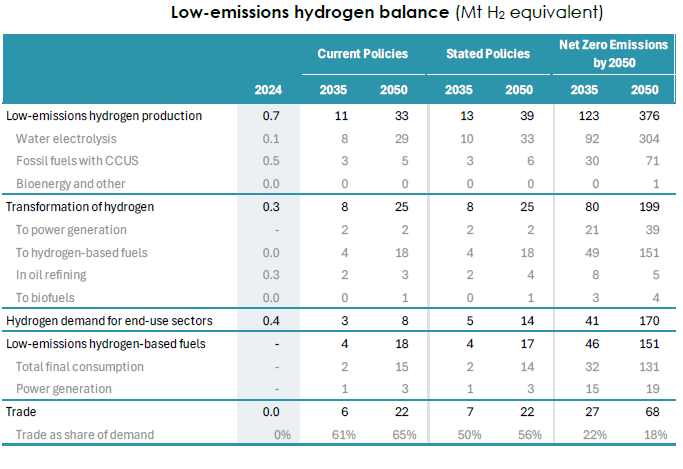
The forecasts under the NZE scenario are noteworthy, for the quantum of requirement compared to the likely development profiles under the other two scenarios, and the required pick up between 2035 and 2050
Under this scenario, required low emissions hydrogen production in 2050 is 376 million tonnes, with 304 million tonnes likely coming from water electrolysis, 71 million tonnes from fossil fuels with CCUS and a small quantum from bioenergy/others
Out of this, 199 million tonnes is expected to be “transformed”, 39 million tonnes to power generation, 151 million tonnes to hydrogen based fuels and balance to oil refining and biofuels
Hydrogen demand for end use sectors is expected to be 170 million tonnes
Hydrogen trade is expected to be 68 million tonnes, or 18% of demand