World Macro economic Forecasts
In its World Energy Outlook, IEA expects the global economy to grow by 2.6% on average annually to 2050 across all scenarios
Out to 2030, IEA’s GDP assumptions at a country and regional level are based on the IMF World Economic Outlook (April 2025), with global GDP projected to grow by 3% annually over this period. This projection is similar to the rate of growth in the IMF October 2025 assessment
After 2030, IEA’s GDP growth assumptions are based on Oxford Economics forecasts and the application of the Solow growth model. The Solow model estimates future GDP on a country and regional basis by accounting for labour supply, capital stock, and total factor productivity (TFP)
TFP growth reflects catch-up dynamics in lower income countries and convergence towards advanced economy levels
IEA has kept economic assumptions constant across the various scenarios to facilitate comparisons between them, although IEA recognizes that decisions taken by policy makers in the energy sector have broader economic Implications
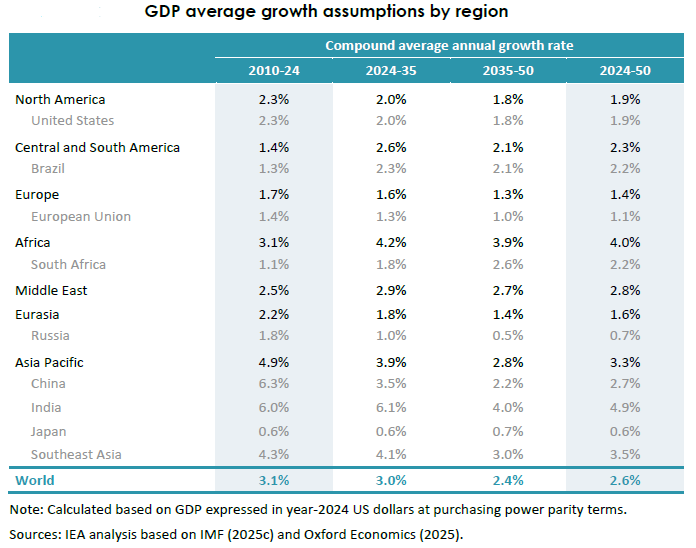
Table below captures IEA’s GDP growth assumptions. GDP is expressed in 2024 US dollars in PPP terms
As can be seen, IEA expects India’s GDP CAGR of 6.1% during 2024-2035, and 4% from 2035-2050, for an average of 4.9% over 2024-2050 period
IEA expects China’s GDP CAGR of 3.5% during 2024-2035, and 2.2% from 2035-2050, for an average of 2.7% over 2024-2050 period
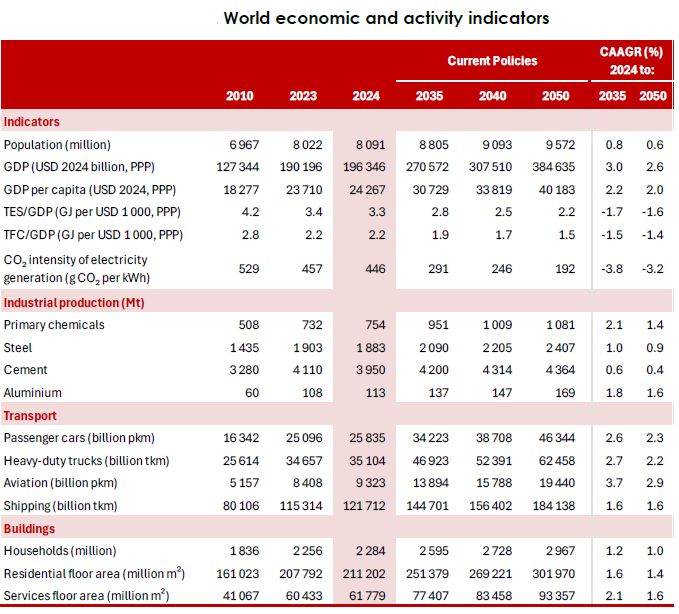
Common to all scenarios, in absolute terms, world GDP, in USD 2024 billion in PPP terms, is forecast to increase from 196,346 billion in 2024 to 384,635 billion in 2050
Coupled with forecast of population increasing from 8,091 million to 9,572 billion, GDP per capita is forecast to increase from $24,267/person to $40,183/person
In the Current Policies scenario, CO2 intensity of electricity generation is forecast to fall from 446 gCO2/Kwh in 2024 to 192 gCO2/KWh in 2050
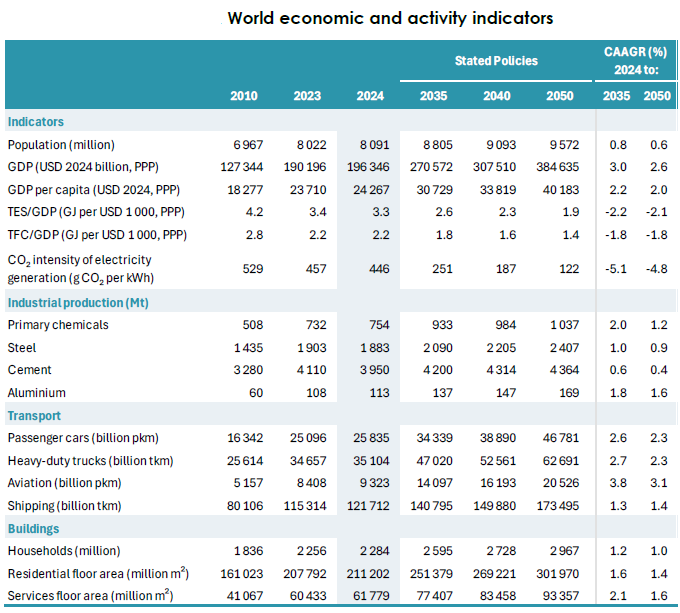
Apart from common forecasts for all scenarios, in the Stated Policies scenario, CO2 intensity of electricity generation is forecast to fall from 446 gCO2/Kwh in 2024 to 122 gCO2/KWh in 2050
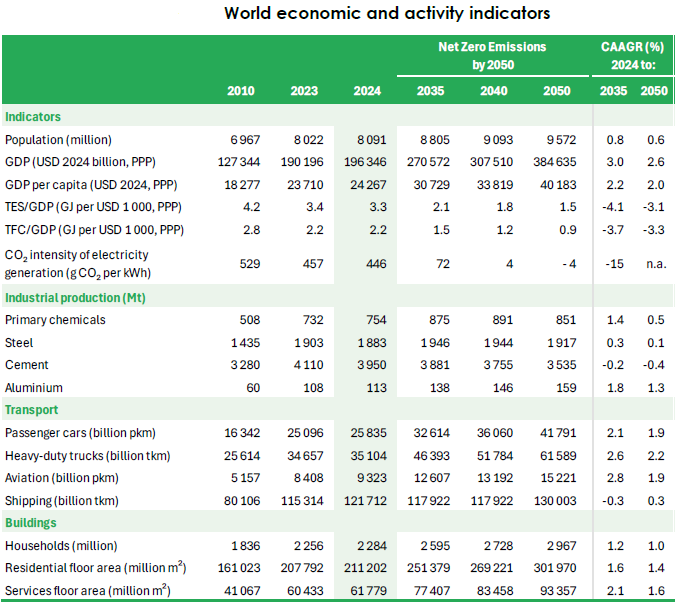
Apart from common forecasts for all scenarios, in the Net Zero Emissions scenario, CO2 intensity of electricity generation is forecast to fall from 446 gCO2/Kwh in 2024 to -4 gCO2/KWh in 2050 (net -ve emissions from electricity sector)
Shifting electricity generation to low-emissions sources and increasing the deployment of low emissions electricity in existing and new end-uses are central to the NZE Scenario. Renewables are expected to account for 89% of total generation, followed by nuclear at 8.5%, and small fossil fuels based generation is coupled with CCUS. Deployment of Bioenergy with Carbon Capture and Storage (BECCS) will lead to net –ve emissions from the electricity sector