
UN Population Prospects Scenarios
The UN Population Prospects scenarios are projections based on different assumptions about fertility, mortality, and migration
In the 2024 revision of the UN World Population Prospects, the future population of each country was projected beginning from 1 January 2024. To project the population forward until 2101, various assumptions were made regarding future trends in fertility, mortality and international migration. Probabilistic methods were used to project future fertility and mortality levels and international migration, specifically to derive the trajectories of the total fertility rate, life expectancy at birth for each sex, and total net migration rates and counts
In addition, several different projection scenarios were produced to convey the sensitivity of the projections to changes in the underlying assumptions
The medium scenario projection corresponds to the mean fertility and mortality and median net migration of several thousand distinct trajectories of each demographic component derived using the probabilistic model of the variability in changes over time. Prediction intervals reflect the spread in the distribution of outcomes across the projected trajectories and thus provide an assessment of the uncertainty inherent in the medium scenario projection.
In addition to the medium scenario and 80 and 95 per cent prediction intervals available from the probabilistic population projections, the 2024 revision includes thirteen deterministic projection scenarios that illustrate the impact of differing assumptions from the medium scenario
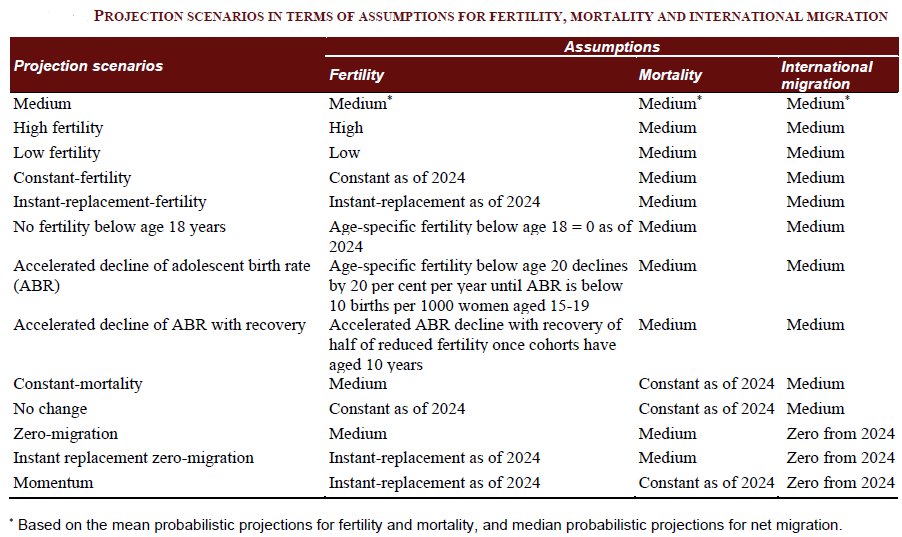
Eight of these scenarios differ only with respect to the level of fertility; that is, they share the same assumptions with respect to the sex ratio at birth, mortality, and international migration
The eight fertility scenarios include five scenarios seen before in previous revisions—medium, low, high, constant-fertility and instantreplacement-fertility—as well as three new scenarios that consider alternative trajectories for fertility among adolescents. A comparison of the results from these eight scenarios allows for an assessment of the effects of different fertility assumptions on other demographic parameters
Under the high scenario, fertility is projected to remain at 0.5 births above the fertility in the medium scenario over the entire projection period except for the initial years. To create a smooth transition between levels observed for the baseline period (2023) and future levels within the high scenario, fertility for the high scenario was assumed to be 0.25 births higher in the first five years of the projection (2024-2028) compared to the baseline, 0.4 births higher in the second five years of the projection (2029-2033), and 0.5 births higher thereafter. Thus, starting in 2034, fertility in the high scenario was assumed to be 0.5 births higher than that of the medium scenario. In other words, a country with a total fertility rate of 2.1 births per woman in some time period under the medium scenario would have a total fertility rate of 2.6 births per woman in the high scenario
Under the low scenario, fertility is projected to remain at 0.5 births below the fertility in the medium scenario over most of the projection period. To ensure a smoother transition between the baseline period (2023) and the low scenario, fertility in the low scenario is initially 0.25 births lower in the first five years of the projection (2024-2028), 0.4 births lower in the second five years of the projection (2029-2033), and 0.5 births lower thereafter. By 2034, fertility in the low scenario is therefore half a child lower than that of the medium scenario. That is, countries reaching a total fertility rate of 2.1 births per woman in the medium scenario have a total fertility rate of 1.6 births per woman in the low scenario
As the name implies, under the constant-fertility scenario, fertility in all countries will remain constant at the level projected for 2024. Meanwhile, mortality and migration assumptions are the same as those in the medium fertility scenario
Under the instant-replacement scenario, for each country, fertility is set to the level necessary to ensure a net reproduction rate of 1.0 starting in 2024 (after taking into account the survival up to reproductive ages). Fertility varies over the remainder of the projection period such that the net reproduction rate always remains equal to one, ensuring the replacement of the population over the long run. Mortality and migration assumptions are the same as those in the medium fertility scenario
For the 2024 revision, three new scenarios were introduced to consider the potential impact of changes in fertility rates among adolescent women and girls:
- The first scenario imagines that fertility rates at ages below 18 years will immediately fall to zero in 2024 and remain at zero throughout the remainder of the century
- The second scenario considers that fertility rates at ages below 20 years decline by 20 per cent annually, beginning in 2024, until the adolescent birth rate falls below 10 births per thousand women aged 15 to 19 years
- A third scenario imagines the same accelerated fertility decline as in the second scenario, but also that half of the reduction in fertility among women and girls younger than 20 years is recovered once those cohorts have aged 10 years (i.e., half of the reduced fertility among women aged 17 is recovered 10 years later among women aged 27)
In addition to the eight fertility scenarios, a constant-mortality scenario, a zero-migration scenario, an instant replacement zero-migration scenario, and a “no change” scenario, that is, both fertility and mortality are kept constant, have been computed
The constant-mortality scenario and the zero-migration scenario both use the medium-fertility assumption, whereas the instant replacement zero-migration scenario uses the instant replacement fertility assumption
The constant-mortality and no change scenarios have the same international migration assumption as the medium scenario. Consequently, the results of the constantmortality scenario can be compared with those of the medium scenario to assess the effect of changing mortality has on population size and composition
Similarly, the zero-migration scenario differs from the medium scenario only with respect to the underlying assumption regarding international migration. Therefore, the zero-migration scenario allows for an assessment of the effect that non-zero net migration has on various population sizes and compositions
When compared to the medium scenario, the no change scenario sheds light on the effects that changing fertility and mortality have on the results obtained
A final scenario called “momentum” illustrates the impact of age structure on long-term population change. This scenario combines elements of three scenarios: the instantreplacement-fertility scenario, the constant-mortality scenario, and the zero-migration scenario