
Conventional Hydro Power
In earlier sections, we have presented detailed tariff assessments for solar and wind power plants, which have no fuel cost, and for coal- and natural gas–based power plants, where fuel cost forms a significant part of the tariff.
In order to avoid repetition of concepts already discussed, this section focuses only on those aspects that are unique to conventional hydro power plants. Pumped hydro projects are not covered here, as they are conceptually different and are effectively treated as energy storage assets.
Key characteristics of conventional hydro power plants
Conventional hydro power plants are characterised by high upfront capital investment, long operating life, and negligible variable cost. Their energy output is governed primarily by hydrology rather than by fuel availability.
Typical indicative characteristics for large conventional hydro projects in India are as follows:
- Capital cost in the range of Rs 6–10 crore per MW
- Auxiliary consumption of around 1%
- Long-term average annual PLF of approximately 40–45%, depending on site-specific hydrology
Tariff structure and role in Merit Order Dispatch
Like solar and wind power plants, conventional hydro power plants have practically zero variable cost. In the Indian power market context, hydro generation is therefore treated as having zero variable cost for the purpose of Merit Order Dispatch (MOD).
Accordingly, whenever hydro energy is available, it is dispatched ahead of thermal generation. This characteristic gives hydro power a privileged position in the dispatch stack and allows it to directly influence Market Clearing Price (MCP) outcomes, particularly during periods of high water availability.
Design Energy – the defining concept for hydro
The most distinctive feature of conventional hydro power plants is the concept of Design Energy.
In India, Design Energy is a Central Electricity Authority (CEA)–approved quantity representing the long-term average annual energy that a hydro project can reliably generate, based on historical hydrological data and design parameters.
The energy output of a conventional hydro power plant is fundamentally constrained by water availability. Design Energy therefore plays a role similar to the denominator in fixed cost recovery: higher Design Energy spreads fixed costs over a larger volume of generation, resulting in a lower per-unit tariff, and vice versa.
Illustrative example: Nathpa Jhakri Hydro Power Station
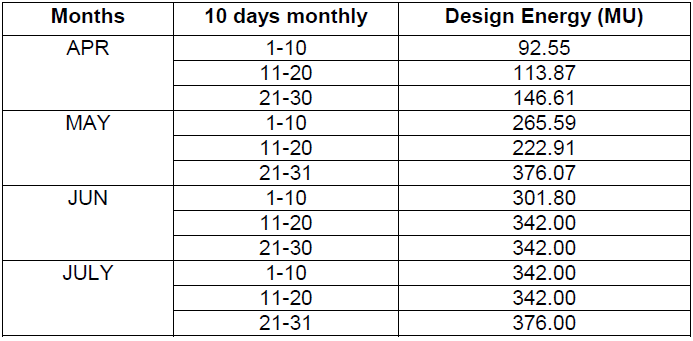
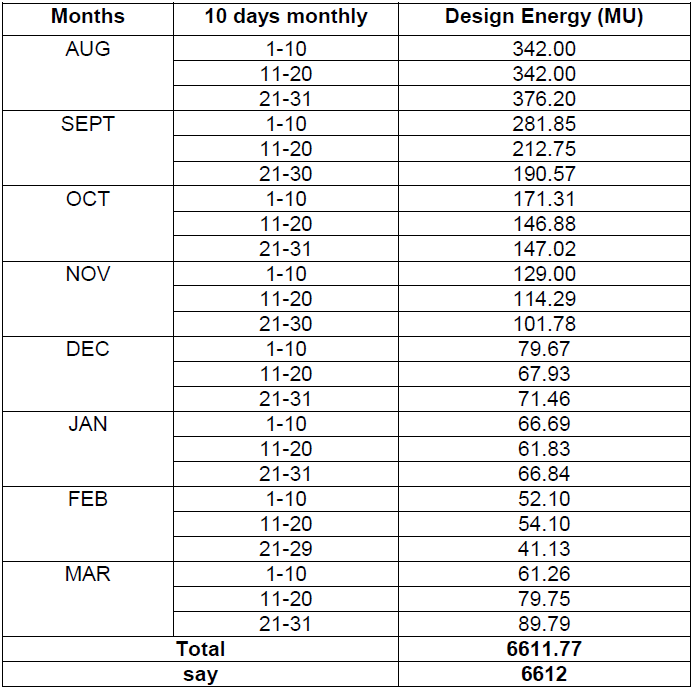
For illustration, we present the Design Energy profile of the 1,500 MW Nathpa Jhakri Hydro Power Station, as approved by the Central Electricity Authority.
The approved annual Design Energy for the project is 6,612 million units, with significant monthly variation. This intra-year variation has important implications for both dispatch patterns and market prices.
Hydro as flexible, low-cost energy
While a conventional hydro power plant is not a battery in the strict sense, a significant portion of its energy output can be regarded as stored electricity, insofar as water retained in the reservoir represents potential energy that can be released when required.
This inherent flexibility allows hydro generation to be scheduled—subject to hydrological and operational constraints—to maximise utilisation during higher-demand or peak-load periods. As a result, hydro power plays a valuable role in system balancing, despite having negligible variable cost.
Implications for MCP and market outcomes
Because conventional hydro power has zero variable cost and meaningful dispatch flexibility, it typically occupies a favourable position in the Merit Order Dispatch stack whenever water is available.
During periods of high inflows, increased hydro generation can materially suppress the Market Clearing Price by displacing higher-cost thermal generation. Conversely, during lean hydrological periods, the system becomes more reliant on coal- and gas-based generation, with corresponding implications for MCP.
Hydro power and power market modelling
The discussion above focuses on average tariff intuition and Design Energy concepts. In practice, hydro power has a large impact on hourly market outcomes due to its seasonal and intraday flexibility.
In our commercial power market and MCP simulation models, hydro generation is therefore represented in significantly greater detail, with explicit modelling of monthly availability and dispatch optimisation, reflecting its critical role in price formation.
This illustrative overview is intended to highlight what makes conventional hydro power fundamentally different from other generation technologies, from both a tariff and system operation perspective.
"Must-Run" Plants
Solar, wind, and conventional hydro power plants have no variable costs and therefore occupy the top of the Merit Order Dispatch stack whenever available.
In addition, certain generation sources—such as nuclear power, biomass, waste-to-energy, are considered as must-run plants— and hence are accorded priority dispatch under prevailing grid and regulatory practices, irrespective of their relative costs. Since their dispatch is not driven by short-run marginal cost considerations, they are not discussed in detail in our illustrative framework.
These generation sources are, however, explicitly accounted for in our commercial power market and MCP simulation models, where their must-run status and system impacts are represented in full.