
Primary Energy Demand Forecasts
(Source: OPEC)
(Source: OPEC`s World Oil Outlook to 2050)
OPEC presents primary energy demand in million barrels of oil equivalent per day (mboe/d), which means demands for all fuels are converted into their oil equivalents in mboe/d (and not in million tonnes of oil equivalent per year)
Read our detailed section Conversion Factors for familiarising with a variety of conversions amongst fuels and units of measurements
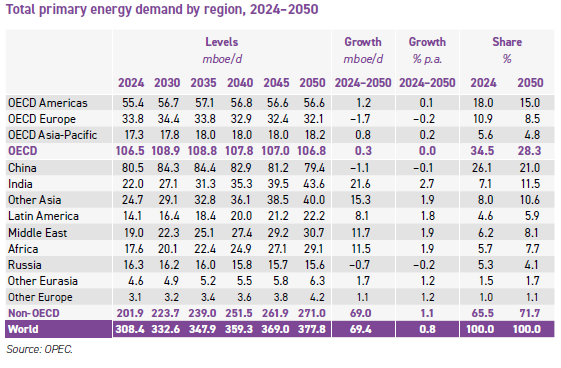
OPEC expects global primary energy demand to increase from 308 mboe/d in 2024 to ~378 mboe/d in 2050, an increase of 23% over the outlook period, or 0.8% p.a. on average.
In our section India Crude Oil Production, we have presented a fairly accurate thumb rule, 1 million b/d of crude approximately equals 50 million tonnes per annum of crude
Therefore 308 mboe/d (or a rounded off 300 mboe/d) translates into ~15,000 MTOE of global primary energy demand, a ballpark global primary energy demand number which many of our readers would likely be familiar with
OPEC expects that primary energy demand growth to 2050 will come almost entirely from developing regions (non-OECD), while energy demand in developed countries (OECD) is expected to stay flat and/or decline
As per OPEC, except for coal, demand for all primary fuels will increase over the outlook period. Demand for coal is expected to sink from 81.8 mboe/d in 2024, to 51.4 mboe/d in 2050 due to unfavourable energy and climate policies, and the penetration of other fuels
Energy demand for oil and gas is expected to increase strongly over the outlook period, in line with strong demand for reliable and affordable energy. Oil demand will rise by 18.2 mboe/d, while natural gas will rise by 19.7 mboe/d between 2024 and 2050
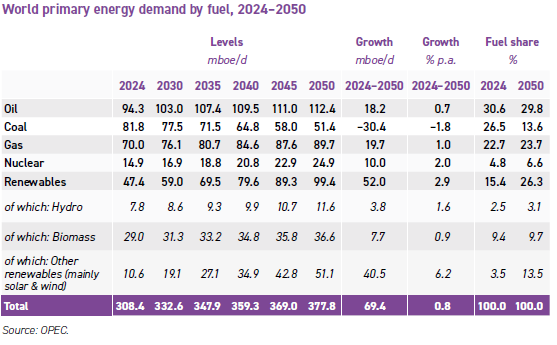
As can be seen from the Table, between 2024 and 2050, share of oil and gas in world primary energy demand is expected to be stable, that of coal to fall from 26.5% to 13.6%, while share of renewables is expected to increase from 15.4% to 26.3% and share of nuclear from 4.8% to 6.6%