Union Finance Minister launches National Monetisation Pipeline 2.0
23rd February 2026
Union Minister for Finance and Corporate Affairs has launched the second phase of asset monetisation pipeline of Central ministries and public sector entities - ‘National Monetisation Pipeline 2.0 (NMP 2.0)’, developed by NITI Aayog, in consultation with infrastructure line ministries, based on the mandate for ‘Asset Monetisation Plan 2025-30’ as announced in the Union Budget 2025-26
The NMP 2.0 estimates aggregate monetisation potential of Rs 16.72 lakh crore, including private sector investment of Rs 5.8 lakh crore under asset monetisation pipeline of Central ministries and public sector entities, over the five-year period from FY 2026 to FY 2030
NMP 2.0 was released in presence of CEO, NITI Aayog and Secretaries of infrastructure line ministries included under the pipeline — Road Transport and Highways, Railways, Power, Petroleum and Natural Gas, Civil Aviation, Ports Shipping and Waterways, Telecommunications, Tourism, Food and Public Distribution, Mining, Coal and Housing and Urban Affairs — along with the Secretaries of Ministry of Finance, Secretary Law, and the Chief Economic Adviser
The Union Minister of Finance observed that the NMP 1.0 was the first of its kind of pipeline at a large scale, and best practices learnt by the authorities concerned should be leveraged in NMP 2.0
She underscored that the learnings and experiences of NMP 1.0 will serve as a guide to ensure that resources and opportunities are optimised to achieve results in a time-bound manner. The Union Finance Minister exhorted all the departments to focus on process simplification and standardisation so that monetisation becomes a seamless experience
She also noted that the five-year asset monetisation target has been set at an ambitious Rs. 16.7 lakh crore, over 2.6 times higher than that under NMP 1.0, and added that the Ministries/Departments must aim to surpass the indicated targets through proactive efforts
Highlighting the significance of asset monetisation, the Union Finance Minister said NMP enables recycling of productive public assets, thereby unlocking resources for reinvestment in new projects and capital expenditure. She noted that this approach facilitates efficient mobilisation of funds for CAPEX in public assets while minimising budgetary outgo of the Government
NMP 2.0 is a culmination of insights, feedback and experiences consolidated through multi-stakeholder consultations undertaken by NITI Aayog, Ministry of Finance and line ministries. Several rounds of discussion have been held by NITI Aayog with the stakeholders. This is a whole of a government initiative
An empowered Core Group of Secretaries on Asset Monetisation (CGAM) under the chairmanship of Cabinet Secretary will continue to monitor the progress of the Asset Monetisation programme. The Government is committed to making the asset monetisation programme, a value accretive proposition both for public sector and private investors/developers, through improved infrastructure quality and operations & maintenance
Proceeds from Asset Monetisation
The proceeds from asset monetisation projects are allocated to four different heads depending on the implementing agency of the project, as well as the project’s mode of monetisation
- Consolidated Fund of India: Any type of Government revenue from a monetisation project that is implemented by a Central Ministry (for example, revenue share, premium, lease rental, royalty) shall flow to Consolidated Fund of India
- PSU/Port Authorities allocation: Proceeds from monetisation activities undertaken by PSUs shall accrue to the concerned PSU (similar norm shall be followed for Major Port Authorities)
- State Consolidated Fund: Certain projects under NMP 2.0 are expected to generate revenues to the State Governments, especially those belonging to the mines and coal sectors (royalty payments). These proceeds shall accrue to State Consolidated Fund
- Direct investment (private): This head shall record the investment by the private sector in monetisation projects that involve construction and/or major maintenance components
MP 2.0 award targets:
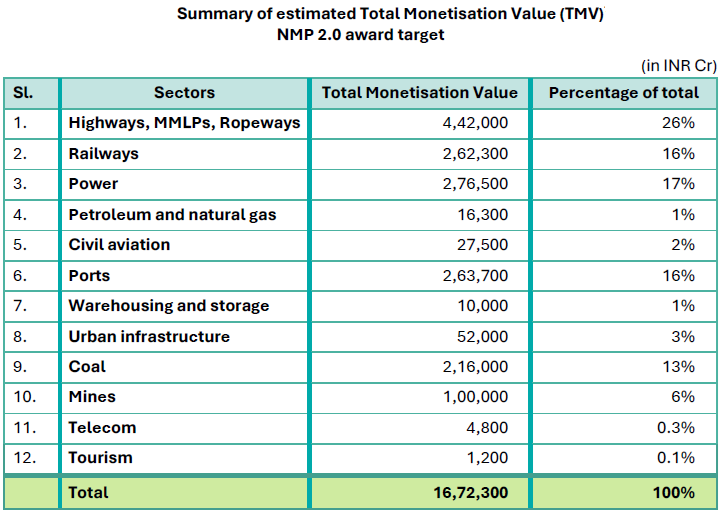
The aggregate asset pipeline under NMP 2.0 over the five-year period, FY 2026-2030, is indicatively valued at INR 16.72 Lakh Crore including private sector investment of INR 5.8 Lakh Crore. The sectors included are highways (including MMLPs, ropeways), railways, power, petroleum and natural gas, civil aviation, ports, warehousing and storage, urban infrastructure, coal, mines, telecom and tourism.
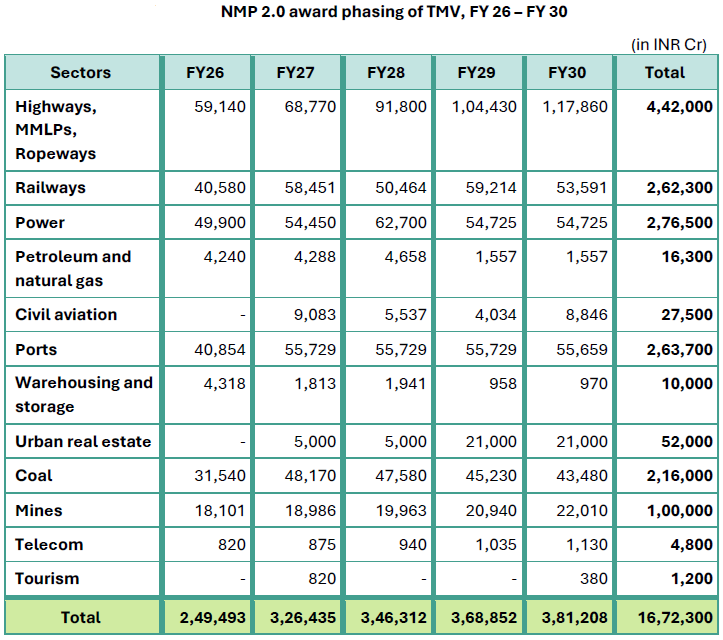
The following Tables provide the details of sectoral targets under NMP 2.0 for the entire five-year period and annual phasing of NMP 2.0 targets sector wise respectively
It is estimated that largest portion of the proceeds under NMP 2.0 shall accrue to Consolidated Fund of India, followed by direct investment (private), PSU or Port Authority allocation and State Consolidated Fund.
The assets and transactions identified under the NMP 2.0 are expected to be rolled out through a range of instruments including direct contractual instruments such as public private partnership concessions, capital market instruments such as Infrastructure Investment Trusts (InvIT) among others. The choice of instrument will be determined by the sector, nature of asset, timing of transactions (including market considerations), target investor profile and the level of operational/investment control envisaged to be retained by the asset owner etc.
The top five target sectors, Highways/MMLPs/Ropeways (Rs. 442,000 cr), Power (Rs 276,500 cr), Ports (Rs 263,700 cr), Railways (Rs 262,300 cr) and Coal (Rs 216,000 cr) collectively account for 87.3% of estimated Total Monetisation value. These are Transport and Energy sectors of the economy. In addition, Civil Aviation, Petroleum and Natural Gas and Mines are also part of the same sectors
We capture snapshot of asset class wise targets for these sectors
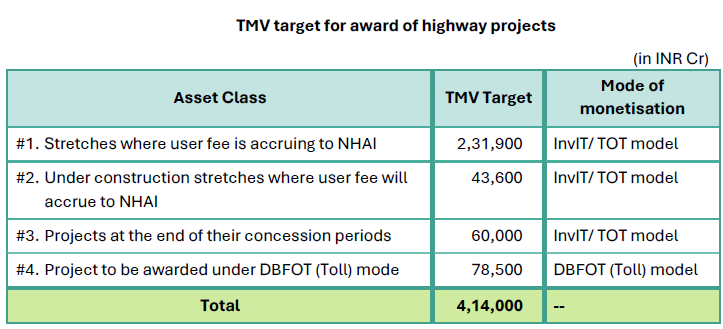
The pool of highway assets identified for NMP 2.0 includes stretches where the user fee is currently accruing to NHAI, stretches which are proposed to be developed on PPP mode, ongoing DBFOT projects that are reverting to NHAI during the NMP 2.0 period and projects currently under development through public funding or under HAM mode which are expected to commence user fee collection during the NMP 2.0 period
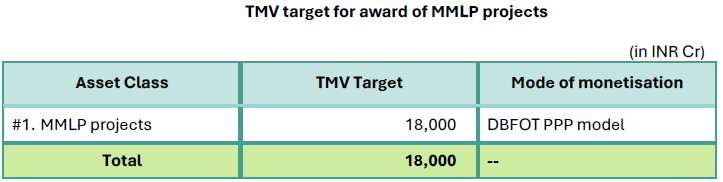
MMLPs are a vital category of projects for monetisation, given the increasing levels of freight movement in the country and the pressing demand for more ejicient logistics services. The Ministry of Road Transport & Highways envisages that these projects shall be developed using the DBFOT model. Through this direct contractual method, projects shall attract private investment for construction of the logistic parks, along with revenue share for the Central as well as State Governments. In view of this, MMLPs are an important addition to the NMP 2.0
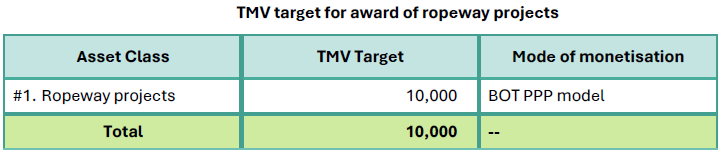
The identified ropeway projects include three projects in Uttarakhand (Govindghat – Hemkund Sahib Ji, Sonprayag – Kedarnath Temple, Kathgodam – Hanumangarhi Temple), one in Arunachal Pradesh (Tawang Monastery – PT Tso Lake), one in Assam (Kamakhya Temple) and one project in Maharashtra (Brahmagiri to Anjaneri, Nashik). Each of these projects is being developed using the DBFOT model and is expected to contribute investment made in the construction and maintenance of the ropeways as monetisation
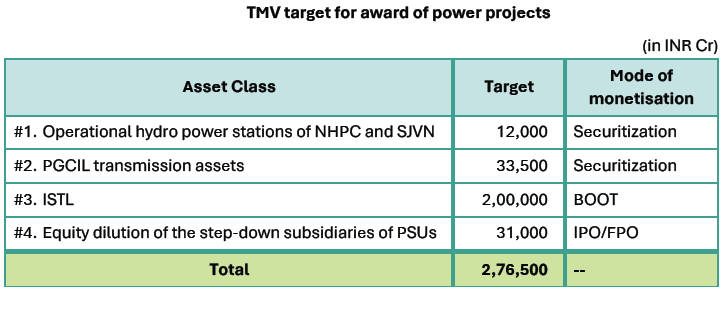
Power sector assets identified for monetisation under NMP 2.0 are aligned with the sector’s objectives of efficient capital recycling and enhanced private participation. The approach emphasizes leveraging established operational assets to mobilize resources for future investments in renewable energy, grid modernization and transmission expansion. Broadly, the identified Asset Classes include securitisation of select operational power generation and transmission projects of PSUs, as well as partial equity divestment of select subsidiaries. The selected assets are in line with the gradual shift towards green energy sources, which are also the preferred investment option for investors
Inter State Transmission Lines (ISTL): The Ministry of Power recognised the need for timely and substantial investment required for the upkeep of ISTL decades ago and has since made consistent efforts to increase competition in provision of transmission services. ISTL projects are awarded on Build-Own-Operate-Transfer (BOOT) mode through tariff based competitive bidding. Investments made in these partnership projects shall be the monetisation value considered under NMP 2.0.
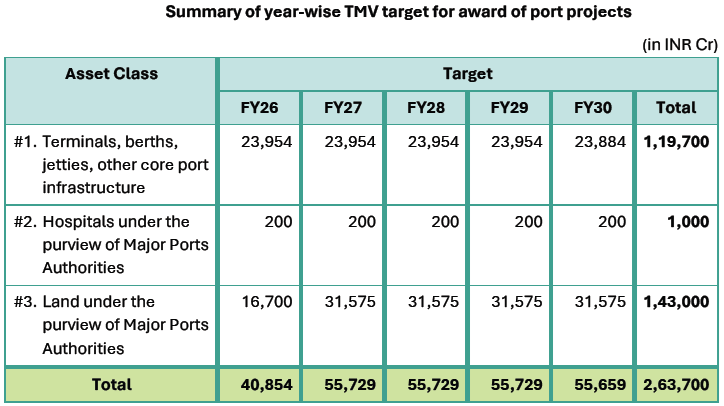
The Ministry of Ports, Shipping and Waterways has been leveraging private sector expertise for development and operations of its infrastructure and provision of its core services for decades. Models used in this sector include various versions of PPPs as well as involvement of private entities in the establishment of captive port facilities
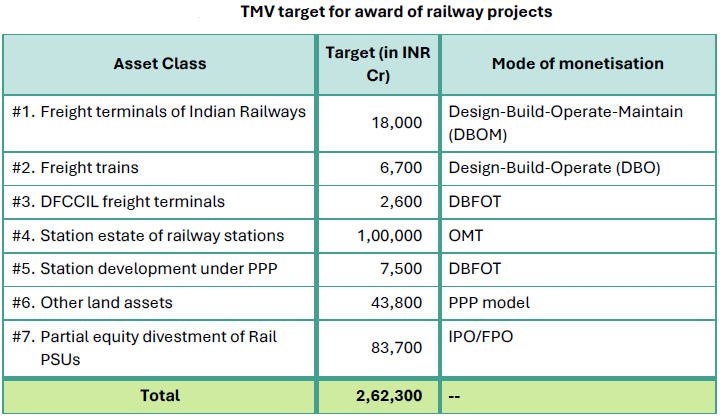
The plan for monetisation of railway assets shall help in modernisation of both freight as well as passenger movement in India. Under NMP 2.0, Ministry of Railways plans to set-up multiple Gati Shakti Multi-Modal Cargo Terminals (GCTs), thus establishing numerous cargo terminals equipped with advanced facilities to handle different types of cargo. The monetisation plan also includes redevelopment of railway stations and their surrounding estate, resulting in discernible improvement in passenger experience and safety. Apart from this, the plan shall also lead to commercial development of multiple rail land parcels and redevelopment of railway quarters
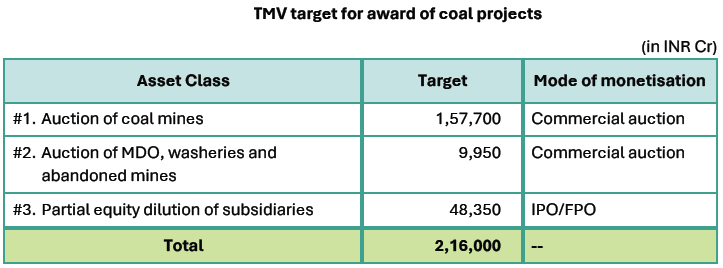
The set of potential assets identified for monetisation align with the sector’s priority of enhancing commercial coal mining. The coal mine blocks identified under NMP 2.0 comprise operational and partially developed mines as well as newly allocated blocks at various stages of exploration and development. The portfolio also encompasses Mine Developer and Operator (MDO) based projects, washeries, and abandoned mine assets, alongside subsidiaries of Coal India Limited (CIL) earmarked for equity divestment
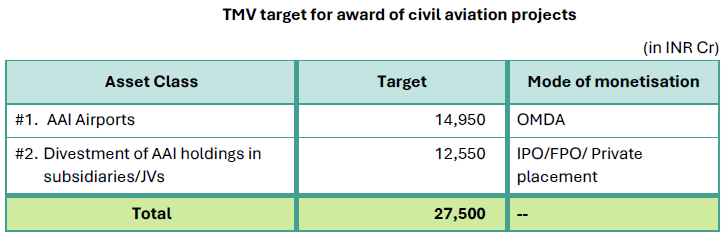
The Ministry of Civil Aviation has successfully leveraged the PPP model to develop key airports in India, spearheading the use of the OMDA model. For NMP 2.0, 26 airports have been identified and are planned to be developed using the OMDA model. Additionally, divestment of Airports Authority of India (AAI)’s stake in one of its subsidiaries and in four Joint Venture (JV) airports is proposed
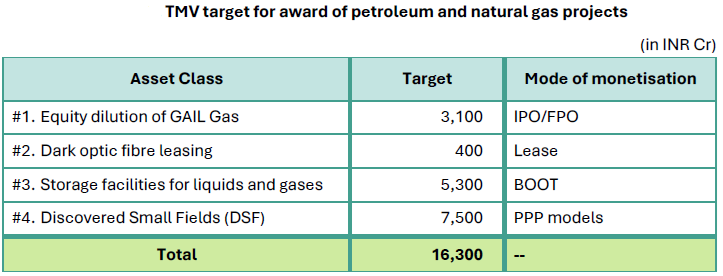
The assets in the Petroleum and Natural Gas sector which have been identified for monetisation during FY26 to FY30 are expected to unlock value from operational assets and commercially viable infrastructure, while safeguarding fuel security and maintaining regulatory continuity. The asset pipeline includes a mix of brownfield and greenfield projects spread across the gas distribution, pipeline, storage and upstream segments. These comprise revenue-generating midstream assets, market-linked utility infrastructure and select upstream fields with extractable reserves. In addition, partial equity divestment has been proposed in identified subsidiaries to mobilise capital for future sectoral investments
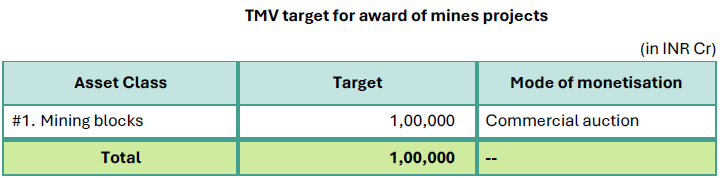
The assets identified for monetisation align with the broader objective of promoting efficient capital recycling, accelerating private investment in mineral resource development and enhancing revenue realisation from the mining value chain. The approach focuses on leveraging future revenue streams from mineral-bearing blocks while maintaining policy continuity, environmental safeguards, and the Government’s strategic interests in critical mineral sectors. The identified assets include a mix of Mining Lease (ML) blocks and Composite Licence (CL) blocks for commercial auction during the period of NMP 2.0. The monetisation potential has been assessed for both ML and CL mining blocks, differentiated by stage of exploration and reserve estimation. The monetisation value has been computed as sum of royalty and premium receivables from auctioned blocks, adjusted for the expected success rate of operationalization