
CEA`s National Generation Adequacy Plan (2026-27 to 2035-36)
19th March 2026
Central Electricity Authority (CEA) has carried out a long-term National Generation Adequacy Study to determine the least cost option for generation capacity expansion from 2026-27 to 2035-36 in order to reliably meet the projected electricity demand
The objective is to minimize the total system cost of generation, which includes the cost of future investments, the cost of operating the entire generation fleet, etc., while ensuring that all technical parameters associated with different power generation technologies are satisfied
The installed generation capacity in India as on 31st January, 2026, stands at 520.5 GW, of which 52% is from non-fossil generation sources. Moreover, during the current financial year 2025–26 (up to 31st January 2026), a record 52.5 GW of generation capacity (from all sources) has been added. Of this, about 43 GW has been from Renewable Energy sources. This is the highest ever capacity addition in a single year. Therefore, India has successfully demonstrated its transition towards clean energy by accelerating the pace of renewable capacity addition
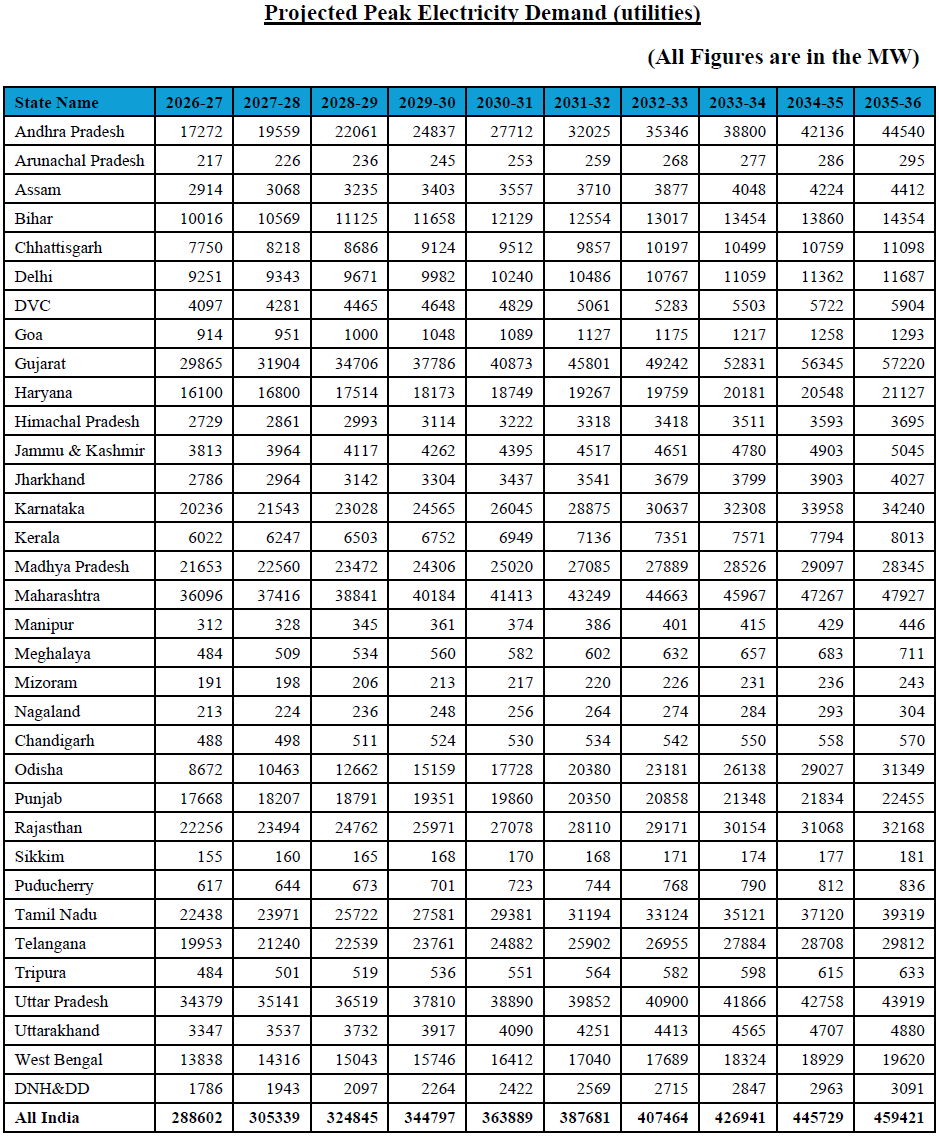
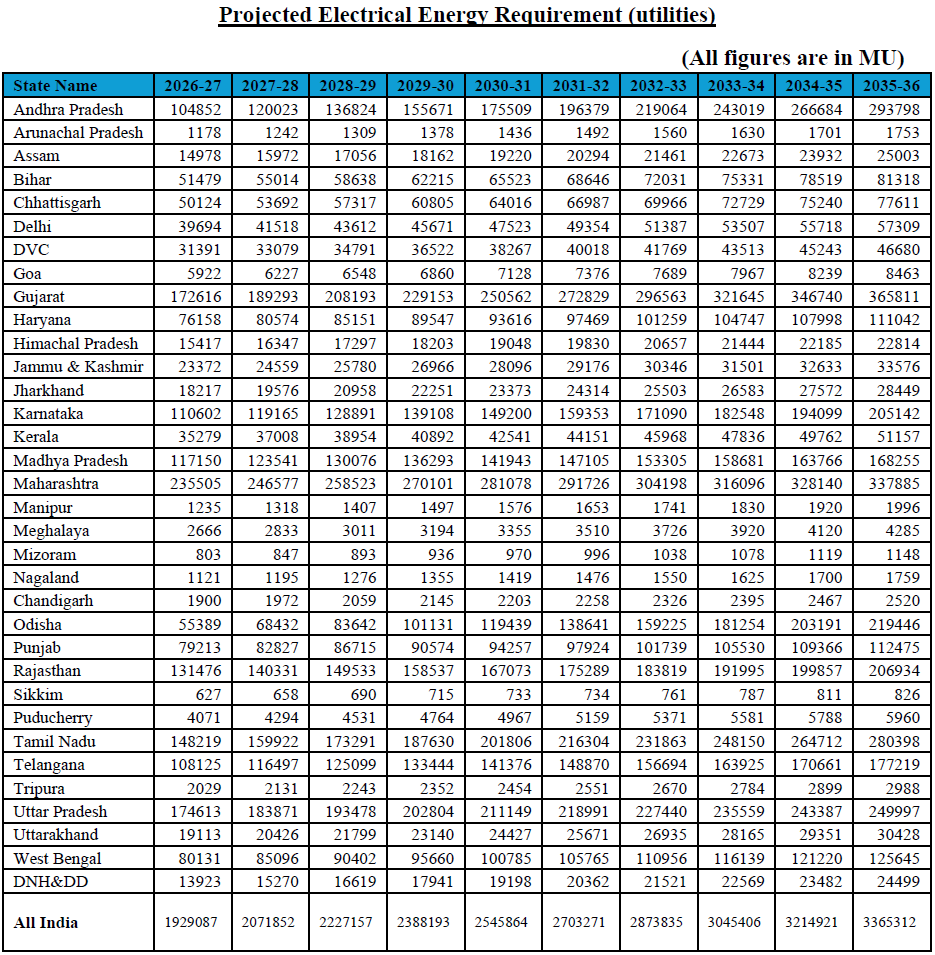
The electricity demand projections as per the mid-term review of the 20th Electric Power Survey (EPS) by CEA indicate that peak electricity demand is expected to increase at a CAGR of 5.58 % during 2024-25 to 2035-36, while the electricity energy requirement is projected to grow at a CAGR of 6.41 % during the same period. The projected peak electricity demand and electrical energy requirement in 2035-36 are 459 GW and 3365 BU, respectively
As per the generation planning studies, the projected installed capacity by the end of 2035-36 is 1,121 GW, comprising 315 GW Coal, 20 GW Gas, 22 GW Nuclear, 78 GW large Hydro, 509 GW Solar, 155 GW Wind, 16 GW Biomass and 6 GW Small Hydro
Additionally, the energy storage installed capacity of 174 GW/888 GWh (BESS of 80 GW/321 GWh and PSP of 94 GW/567 GWh) is envisaged by 2035-36. The non-fossil fuel-based installed capacity would be about 786 GW i.e 70% of the total installed capacity by 2035-36, as compared to 52% in January 2026
Similarly, the fossil fuel-based installed capacity would be about 30% in 2035-36 as compared to 48% in January 2026
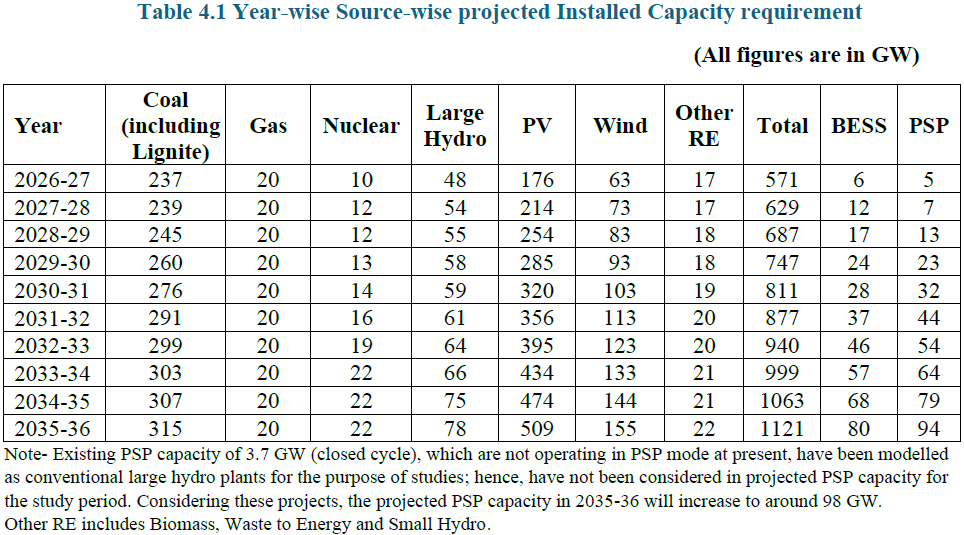
The installed generation capacity projection in 2035-36 shows that the country is moving toward a strong transition to non-fossil energy. Renewable sources, especially solar PV, hydro and wind, will dominate future capacity, supported by Energy Storage Systems. With this, the country will significantly increase its clean energy capacity and strengthen energy security
Reliability studies are an important part of generation adequacy planning as it helps assess whether the power system can consistently meet electricity demand under different uncertain conditions. Variations in electricity demand, variations in renewable energy generation (solar, wind, hydro), and possible outages of thermal power plants have been considered in the study. Additionally, in line with the increasing requirement for clean firm power to meet the growing electricity demand, the study also underlines the likely growth of nuclear-based generation capacity to reach 100 GW by 2047
As evident from recent tenders, the cost of BESS has reduced, and Solar plus BESS has emerged as an alternative to meet electricity demand during solar hours and morning/evening peak/high demand (non-solar) hours
However, considering reliability, firm power sources are required in the system which can be dispatched 24x7 round the year and in the Indian context, the source of firm power at present is predominantly coal-based generation. Additionally, coal-based generators located at pit head sites or near pit head sites are found to be cost-effective as a source of base load power as compared to the combination of Solar and BESS
As this study is based on certain assumptions that may change over time, the results may vary due to the dynamic nature of the Indian power sector. Accordingly, the study will be reviewed and revised annually