
Cabinet approves royalty rates for mining of 12 critical and strategic minerals
29th February 2024
The Union Cabinet has approved the amendment of Second Schedule to the Mines and Minerals (Development and Regulation) Act, 1957 for specifying rate of royalty in respect of 12 critical and strategic minerals, viz. Beryllium, Cadmium, Cobalt, Gallium, Indium, Rhenium, Selenium, Tantalum, Tellurium, Titanium, Tungsten and Vanadium
This completes the exercise of the rationalisation of royalty rates for all 24 critical and strategic minerals
It may be noted that the Government had notified the royalty rate of 4 critical minerals, viz., Glauconite, Potash, Molybdenum and Platinum Group of Minerals on 15th March, 2022 and of 3 critical minerals, viz., Lithium, Niobium and Rare Earth Elements on 12th October, 2023
Recently, the Mines and Minerals (Development and Regulation) Amendment Act, 2023, which has come into force from 17th August, 2023, had listed 24 critical and strategic minerals in Part D of the First Schedule of the MMDR Act. The amendment provided that mining lease and composite licence of these 24 minerals shall be auctioned by the Central Government
This approval of the Union Cabinet for specification of rate of royalty will enable the Central Government to auction blocks for these 12 minerals for the first time in the country. Royalty rate on minerals is an important financial consideration for the bidders in auction of blocks. Further, manner for calculation of average sale price (ASP) of these minerals has also been prepared by the Ministry of Mines which will enable determination of bid parameters
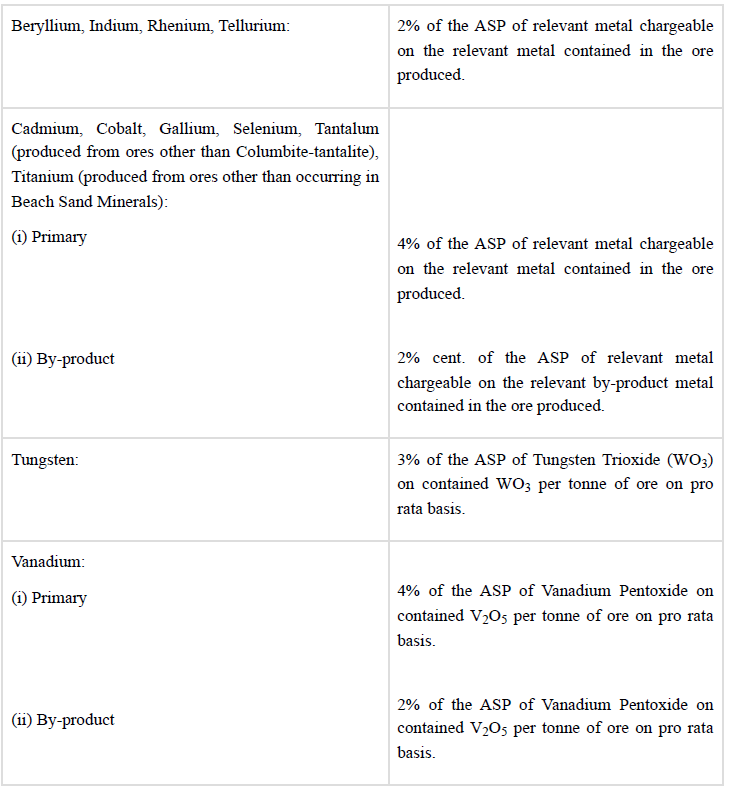
The Second Schedule of the MMDR Act provides royalty rates for various minerals. Item No. 55 of the Second Schedule provides that royalty rate for the minerals whose royalty rate is not specifically provided therein shall be 12% of the Average Sale Price (ASP). Thus, if the royalty rate for these is not specifically provided, then their default royalty rate would be 12% of ASP, which is considerably high as compared to other critical and strategic minerals. Also, this royalty rate of 12% is not comparable with other mineral producing countries. Thus, it was decided to specify a reasonable royalty rate as below:
Critical minerals have become essential for economic development and national security in the country. Critical minerals such as Cadmium, Cobalt, Gallium, Indium, Sellenium and Vanadium and have uses in batteries, semiconductors, solar panels, etc. These minerals have gained significance in view of India's commitment towards energy transition and achieving net-zero emission by 2070. Minerals like Beryllium, Titanium, Tungsten, Tantalum, etc. have usage in new technologies, electronics and defence equipment. Encouraging indigenous mining would lead to reduction in imports and setting up of related industries and infrastructure projects. The proposal is also expected to increase generation of employment in the mining sector
Geological Survey of India (GSI) and Mineral Exploration & Consultancy Ltd. (MECL) have recently handed over the exploration report of 13 blocks containing one or more of critical minerals like Cobalt, Titanium, Gallium, Vanadium and Tungsten. Further, these agencies are conducting exploration for these critical and strategic minerals in the country
The Central Government has launched the first tranche of the auction of critical and strategic mineral blocks in November, 2023 for minerals such as Lithium, REE, Nickel, Platinum Group of Elements, Potash, Glauconite, Phosphorite, Graphite, Molybdenum, etc. which is getting positive response from the industry. Total 20 mineral blocks are being auctioned in the first tranche