
SECI RfS for 1,000 MW of Round-the-Clock Thermal Mimic (RTC-TM) Power
10th March 2026
SECI has invited proposals for setting up ISTS-connected Renewable Energy (RE) Projects for supply of 1,000 MW power on a Round-the-Clock (RTC) basis from ISTS-connected RE power projects in India, under the Build-Own-Operate (BOO) model.
SECI shall enter into a Power Purchase Agreement (PPA) with the successful bidders selected through this RfS, for procurement of power for a period of 25 years, in accordance with the terms, conditions, and provisions specified in the RfS and the PPA
We present below some of the key features of this 138-page RfS document
Solar Energy Corporation of India Limited (hereinafter referred to as “SECI”) is a “Navratna” Government of India Enterprise under the administrative control of the Ministry of New & Renewable Energy (MNRE). One of the main objectives of the Company is to assist the Ministry and function as the implementing and facilitating arm of the National Solar Mission (NSM) for development, promotion and commercialization of solar energy technologies in the country
Government of India’s continued emphasis on enhancing RE power’s share in the national energy mix has transformed Indian energy sector significantly. With the intervention of Government of India, through MNRE, the risks associated with solar and wind power sector have been brought down by way of advanced arrangement of land and evacuation through solar parks, green energy corridors, a secure and standardized PPA for 25 years with elaborate mechanism for risk apportionment and compensations, payment security, etc.
The rapid growth trajectory of renewable energy (RE) witnessed in the past decade has led to innovative solutions being designed, with increasing focus on increasing dependency on RE power for meeting the daily demand of Distribution Companies (DISCOMs). With the advancement in Energy Storage technologies, coupled with downward trend of energy storage costs, the RE sector offers a unique opportunity to offer “firm and dispatchable” supply of power to Buying Entities, including DISCOMs
With the objective to provide firm and dispatchable RE (FDRE) power to the DISCOMs through renewable energy sources, to facilitate the scale up of renewable capacity addition and achieve economies of scale, to facilitate fulfilment of RPO and ESO requirement of the obligated entities, Ministry of Power has issued “Guidelines for Tariff Based Competitive Bidding Process for Procurement of Firm and Dispatchable Power from Grid Connected Renewable Energy Power Projects with Energy Storage Systems,” vide Gazette Resolution no. 23/03/2023-R&R dated 09.06.2023. These Guidelines have been issued under the provisions of Section 63 of the Electricity Act, 2003 to enable procurement of FDRE by DISCOMs from Grid-connected RE Projects, complemented with Energy Storage, through tariff based competitive bidding process
Power procured by SECI from the Projects under this RfS has been provisioned to be sold to the different Buying Entities of India. The details of Buying Entities shall be intimated later
Under this RfS, the RE Power Developer (RPD) shall be required to set up ISTS-connected RE Power Project(s) with Energy Storage System (ESS), including the transmission network up to the Interconnection/ Delivery Point(s), with the primary objective of supplying RE power to SECI, at its own cost and as per the provisions of the RfS and PPA
Identification of land, installation and ownership of the Project(s), along with obtaining connectivity and necessary approvals and interconnection with the ISTS network/STU or InSTS network (as applicable) for supply of power to SECI, will be under the scope of the RPD. For the purpose of STU interconnection, RPD may install the Project in the same State where the Buying Entity is located
The Projects to be selected under this scheme provide for deployment of RE Power Projects, along with Energy Storage System (ESS). However, the selection of Projects would be technology agnostic
Selection of RE Power Projects for a total Contracted Capacity of 1000 MW will be carried out through e-bidding followed by e-Reverse Auction process
RE Projects are required to be designed for interconnection with the ISTS substation at voltage level of 220 kV or above. However, for STU/InSTS connected project, voltage level may be as per the concerned State Regulations
The RfS has been issued for procurement of cumulative “Contracted Capacity” of 1000 MW, which corresponds to RTC power from the Projects
Energy Storage Systems (ESS) shall mandatorily constitute part of the Project. It is clarified that ESS charged using a source other than RE power would not qualify as RE power
As an example, for a Contracted Capacity of 250 MW, the “Installed Capacity” as per the General Network Access (GNA) Regulations can be more than Contracted Capacity. Project Capacity shall mean rated AC capacities of Solar PV, Wind power and other RE based components along with energy storage as committed to be installed under the PPA, and shall be equal to the installed capacity committed under the Connectivity granted under the GNA Regulations
The RE component sizing should be suited to meet the RTC power supply requirement of the Buying Entity as covered in Demand Fulfilment Ratio section below
A Bidder, including its Parent, Affiliate or Ultimate Parent or any Group Company shall submit a single bid offering a minimum quantum of cumulative Contracted Capacity of 100 MW and a maximum quantum of 500 MW, in the prescribed formats. The cumulative Contracted Capacity shall be quoted in integral values only
The Projects can be located anywhere in India, at the locations chosen by the Bidder/RPD at its own discretion of and risk, cost and responsibility. For a single Project, the RE generation components, along with ESS, may either be co-located, or may be located at different locations. The different Project components can be connected with ISTS network at different ISTS sub-stations
The Project should be designed for interconnection with the ISTS/ InSTS in accordance with the prevailing CERC/ SERC regulations in this regard
In case the Buying Entity is located in the same State where the Project is located, the RPD may choose to interconnect the Project at the STU/InSTS Substation at a minimum voltage level as per the applicable State regulations, subject to acceptance of such an arrangement by the Buying Entity
In such cases, relevant provisions of the RfS, PPA and PSA documents referring to ISTS Substations at the Delivery Point shall also mean STU/InSTS substations, wherever applicable. Similarly, reference to CEA regulations with respect to connectivity and synchronization with the grid will also mean reference to the applicable SERC/State Government regulations for InSTS-connected Projects
The procurement shall be in power (MW) terms. The RPD shall supply RE power in Round-the-Clock manner by maintaining the following Demand Fulfilment Ratios (DFR):
- a minimum DFR of 90% in each time-block during the Peak Hours;
- a minimum DFR of 80% in each time-block during the off-Peak Hours; provided that the RPD may designate, by prior written notice to the Buying Entity latest by 31st May of that year, any two calendar months between (and including) July and September, during which the minimum DFR requirement in each time-block during the off-Peak Hours shall stand relaxed to 70%, such designation being limited to complete calendar months only;
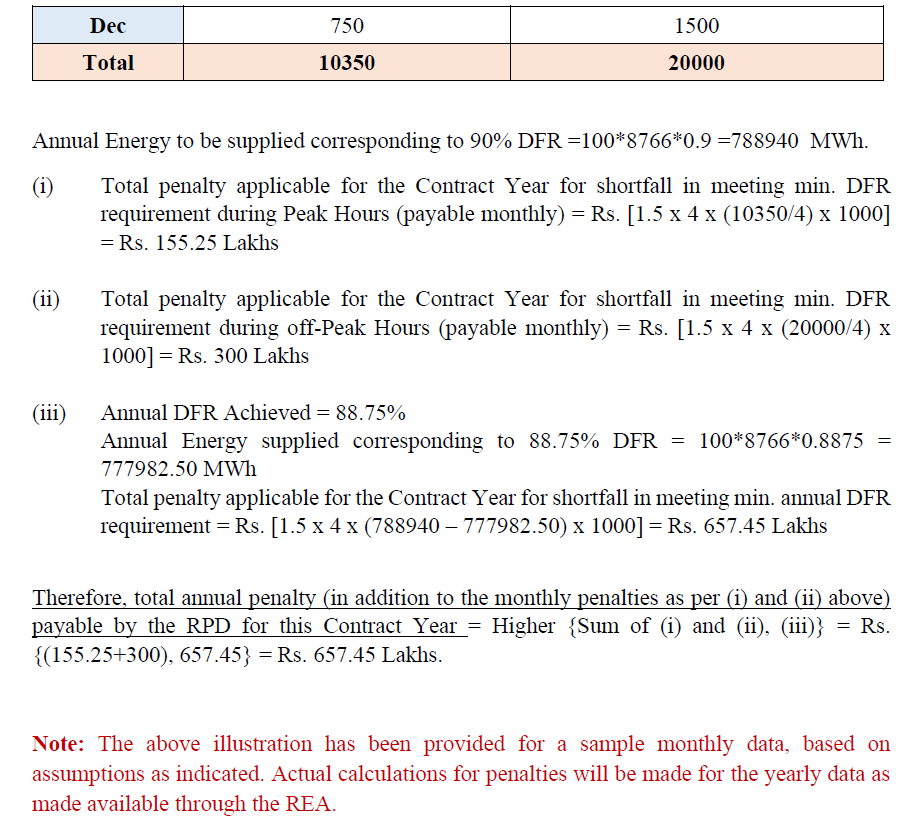
- a minimum DFR of 90% on annual basis
The RPD’s performance against this metric will be measured by:
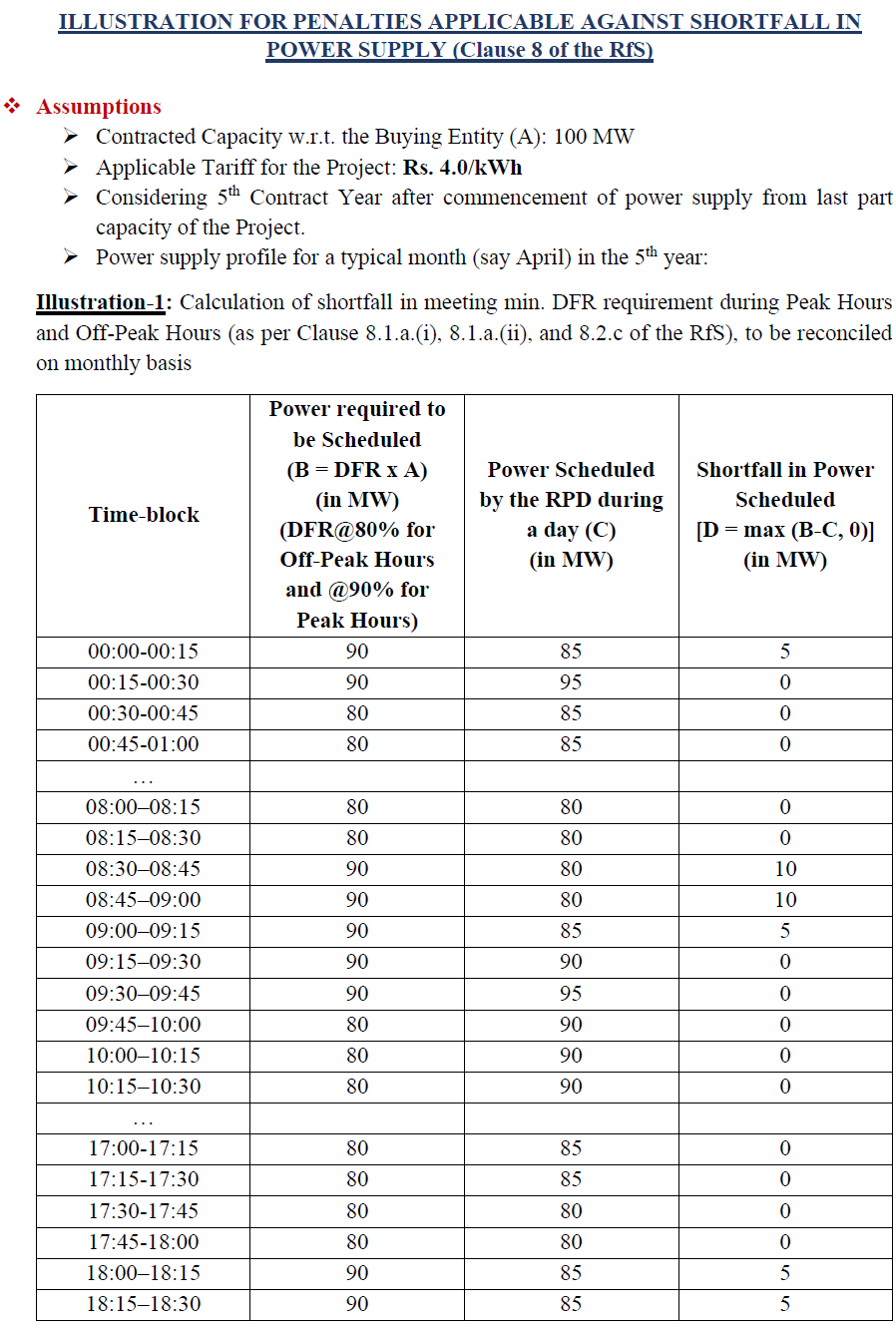
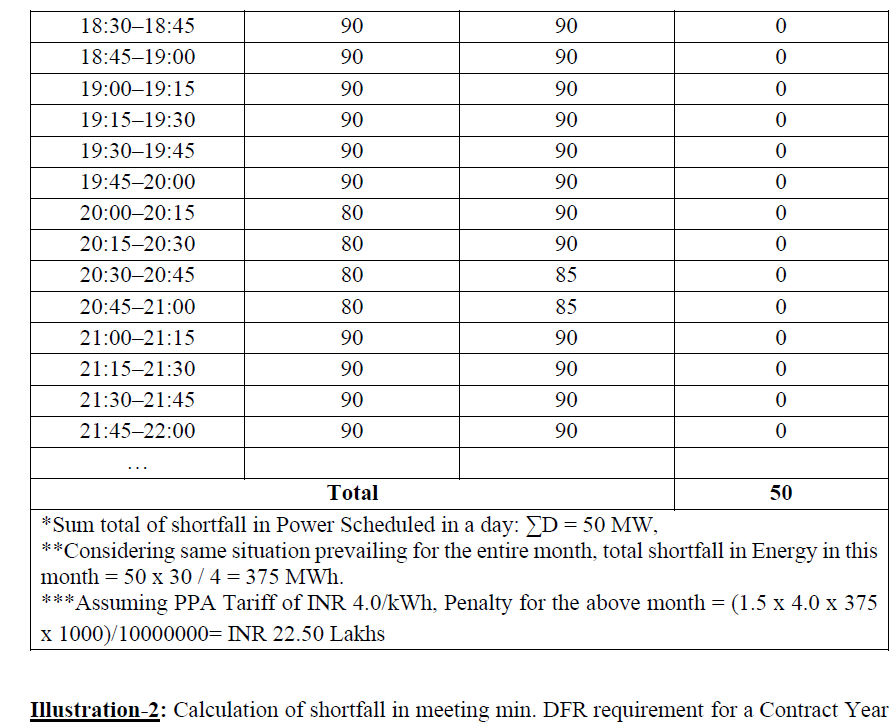
- adding up the shortfall of each time-block in meeting the min. DFR requirement during the Peak Hours;
- adding up the shortfall of each time-block in meeting the min. DFR requirement during the off-Peak Hours;
Penalty for both the above shortfalls will be calculated on time-block wise basis and will be reconciled on monthly basis. This aggregate penalty of both the above shortfalls shall be recovered on monthly basis from the subsequent monthly bill. However, it is further clarified that in the event a project is being mapped with two or more Buying Entities, the penalty for both the above shortfalls shall be calculated separately for each Buying Entity considering peak and off-peak hours of respective Buying Entity
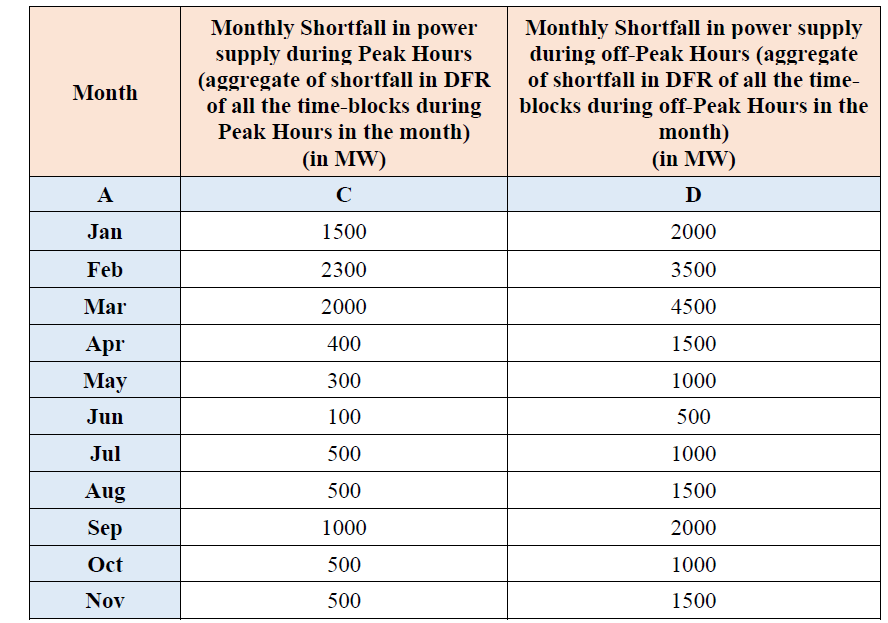
- averaging the DFR of all the time-blocks in a Contract Year, to measure the DFR compliance on annual basis
The above shortfall will be reconciled on annual basis for each Contract Year. In a Contract Year, higher of the two penalties ((sum of (i) and (ii) for all the months of the Contract Year), (iii)) shall be levied on the RPD and the same shall be recovered from the subsequent monthly bill
The Buying Entity shall choose any 6 hours on a daily basis between 00:00 Hrs. to 10:00 Hrs. and 18:00 Hrs. to 24:00 Hrs. of a day, which shall be the ‘Peak Hours’ for that day. For the purpose of scheduling, a ‘day’ shall commence from 00:00 Hrs. and end at 24:00 Hrs. These 6 hours shall be intimated by the Buying Entity on day-ahead basis and will constitute the Peak Hours for that day. All remaining hours outside these 6 Peak Hours chosen by the Buying Entity shall be referred to as ‘Off-Peak Hours’
The amount of penalty against shortfall for each of the min. DFR requirements shall be equal to 1.5 times the cost of this shortfall in energy terms, calculated at the PPA tariff, and as illustrated below:
In order to allow optimization of operation of RE Power generating systems, the RPD is allowed to supply power in excess of the Contracted Capacity in any time-block, to any third party or power exchange, without requiring any No-Objection Certificate (NOC) from SECI/Buying Entity. In case such power is purchased by the Buying Entity, it shall be purchased at the PPA tariff (plus SECI’s trading margin). It may be noted that at any instance of energy supply from the Project, priority shall be accorded to meet the energy requirements as per PPA, before selling any quantum in the open market
Any instance of third-party sale of power from the Project by the RPD, while the Contracted Capacity in any-time block remains unfulfilled, shall constitute a breach of RPD’s obligations under the PPA and make the RPD liable for additional penalty @2 times of extant market rate/kWh (reference rate being the highest of the applicable rates in the DAM/G-DAM/RTM of all Power Exchanges operating in India on that day) for the quantum of such sale. In the event of early part commencement of power supply from the Project/ early commencement of supply of power from individual Project component/ non-availability of GNA/ transmission line constraints/ intentional scheduling of power by the RPD to a third party/ any other case, SECI shall analyze the actual constraints and power evacuation details and the applicability of this penalty shall be determined based on this analysis