
Press Note on release of the Report of the Expert Committee on Energy Statistics
6th July 2026
The Ministry of Statistics and Programme Implementation (MoSPI) has released the report of the Expert Committee on Energy Statistics. The key recommendations made by the Expert Committee are related to methodologies on contribution of Biofuels, filling up of demand and supply side data gaps especially captive power and consumption of electricity by EVs
Energy plays a pivotal role in driving economic growth and supporting social development. The “Energy Statistics India”, an annual publication of the Ministry of Statistics and Programme Implementation (MoSPI) depicts the flow-of-energy at national level containing diverse tables, graphs and sustainable energy-Indicators following International Standards and guidelines
As India progresses towards its renewable energy targets and Net Zero aspirations, the need for a robust, comprehensive and harmonized energy statistics framework has become increasingly important to support evidence-based policymaking and facilitate effective monitoring of the ongoing energy transition
Recognizing this need, the MoSPI constituted an Expert Committee on Energy Statistics under the Chairmanship of Dr. Rangan Banerjee, Director, IIT-Delhi comprising senior level representatives from line energy-Ministries and domain experts from research institutions like The Energy Research Institute (TERI), Alliance for Energy Efficient Economy (AEEE) etc.
The Committee undertook a comprehensive review of the “Energy Statistics India” publication and the energy-Statistics database of India, including its coverage, definitions, classification systems, data sources and estimation methodologies. Focused attention was paid to issues like meeting International Standards on Energy Statistics, addressing the major data-gaps and addressing the inconsistencies in energy-Statistics database of India across energy-Ministries
The Committee had several rounds of technical consultations and deliberations with line Ministries, agencies and subject experts before finalizing its recommendations. The major recommendations of the Committee have been summarized below;
- The Committee recommended the adoption of the international standards in collection and dissemination of energy-Statistics in tabulation categories aligned with International Standard Industrial Classification (ISIC) Rev. 5, National Industrial Classification (NIC)-2025, Standards International Energy-product Classification (SIEC) etc. The Committee also urged for adaptation of uniform conversion factors by all the line energy-Ministries to ensure the inter-Ministerial consistency of the energy-Statistics produced by them
- The Committee recommended a methodology for refinement of sectoral end-use consumption of the Imported coal (which is around 20% of the total coal-consumption in India) and also the domestic coal routed via auction, clubbed under the miscellaneous category. The methodology makes use of Annual Survey of Industries (ASI) database which captures limited industry-wise consumption of Coal. The Committee also recommended the Bureau of Energy Efficiency (BEE) to develop and maintain a comprehensive database under Perform, Achieve and Trade (PAT) scheme
- The Committee recommended similar methodology for capturing and dissemination of the industry-wise end-use consumption of electricity in India by using Annual Survey of Industry (ASI) database
- In absence of a consolidated national level data, the United Nation Statistical Division (UNSD) in their annual publication of World Energy Balance estimates the consumption of the Bio-fuel of India to the tune of around 31-34% of the total annual energy-consumption of India; based on their own estimation. The Committee recommended a comprehensive methodology for addressing this important data-gaps for incorporating the component of Bio-fuel in the energy-Balance table of India
- The consumption of electricity via captive/off-grid mode and consumption of electricity by EVs in India are among the significant data-gaps in the energy domain which has been addressed under this report. The Committee recommended initial methodological framework for these, which needs further refinement by the users and researchers for suitable incorporation in the energy-Balance database of India
The report presents a detailed account of these deliberations along with actionable recommendations aimed at strengthening the methodological robustness, analytical usefulness and inter-agency consistency of India's energy statistics system. The recommendations are expected to support evidence-based policymaking, improve data quality and comparability, and facilitate better monitoring of India's evolving energy landscape
MoSPI emphasizes that effective implementation of the recommendations will require continued collaboration and coordination among all concerned Ministries and stakeholders to build a more integrated, reliable and internationally comparable energy statistics framework for the country
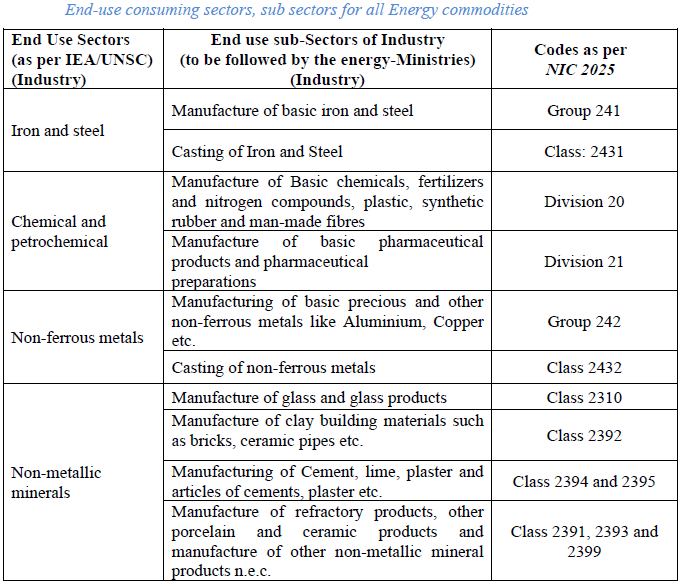
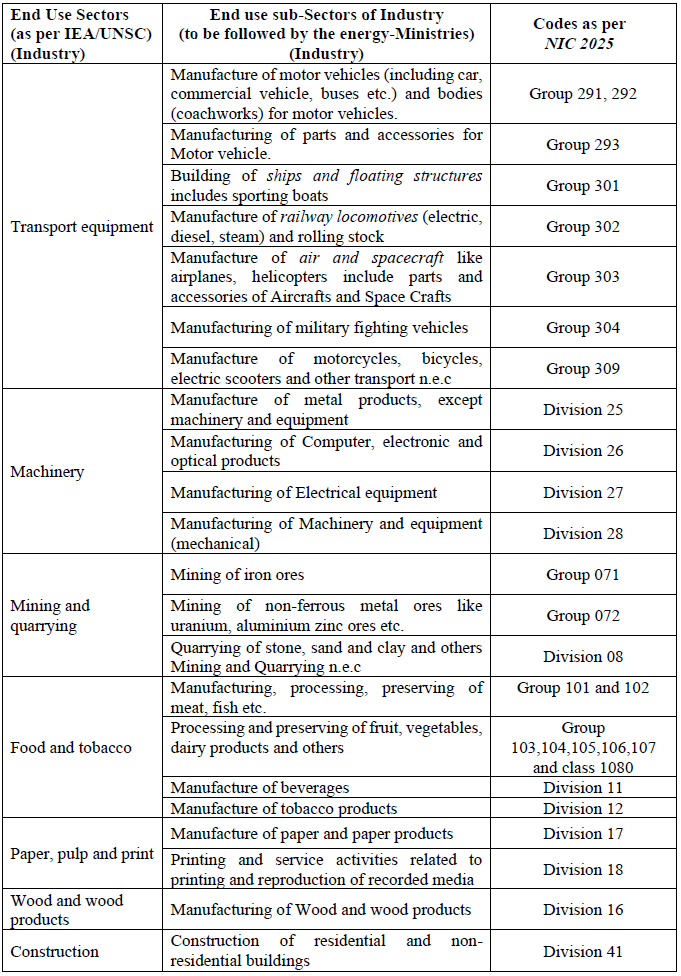
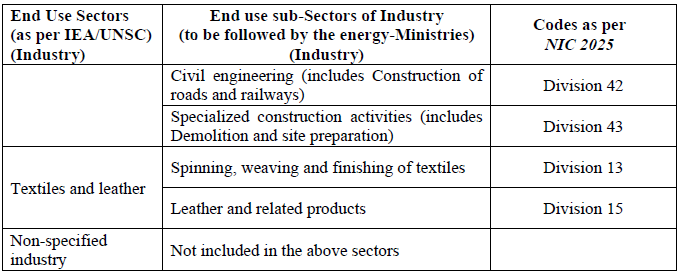
- Uniform adoption of sectoral-end-use categories for reporting consumption of energy commodities:
Recommendation: In order to ensure uniformity and harmonization in the energy-Statistics database of India, all the line energy-Ministries should capture the statistics on standard sectoral end-use consumption of energy-commodities. The Table below provides the disaggregated level end-use consuming sectors which are in accordance with the ISIC Rev. 5 and NIC-2025. The Committee recommended the line energy-Ministries to report data as per these categories - Use of Standard International Energy-product Classification (SIEC):
Recommendation: A concordance between the domestic classification of energy-commodities with the International standards of SIEC, prescribed under IRES, needs to be developed. The same is indispensable for harmonising the database and international comparison - Conversion Factors of energy-commodities:
Recommendation: The use of uniform conversation factors among all the energy-Ministries is indispensable to ensure inter-consistency of statistics across databases maintained by them in terms of energy-units. The Committee reviewed and recommended the conversion factors maintained by MoSPI in its’ annual publication ‘Energy Statistics India’ for their adoption by other line energy-Ministries
- Data-gap in capturing the end-use consumption of domestic and imported Coal into different end-use sectors:
Recommendation: The methodology recommended by the Committee using the ASI database of MoSPI to bridge the above-mentioned data-gap, may be used by MoSPI in its’ annual publication of Energy Statistics India, till more structured and time-series statistics from PAT (Perform, Achieve and Trade) from BEE, M/o Power is available - Data-gap in capturing the end-use consumption of High-Speed Diesel (HSD) against Retailers/Resellers:
Recommendations: Based on the survey conducted during Oct-20 to Sep-21, the CRISIL report submitted to PPAC, MoPNG provides distribution of consumption figure of HSD sold to Retail/Resellers, into different end-use consuming sectors. MoSPI may adopt this categorization till better and more recent data becomes available. The Committee also recommended PPAC/MoPNG to conduct such studies more frequently to update these data - Non - capture of consumption of electricity against sub-sectors under Industry:
Recommendation: At present CEA and DISCOM do not maintain the industry-wise consumption of electricity. A methodology to estimate industry-wise consumption using the ASI database of MoSPI has been developed. The Committee reviewed and recommended the methodology to estimate the consumption of electricity into different sub-sectors under Industry - Incorporating the component of Bio-fuel:
Recommendation: The statistics on Bio-fuel should be captured using the methodology proposed under the study report by MNRE and TERI. The Committee recommends to use the same while preparing the energy-profile at the national level - Capturing the Demand side consumption of Energy statistics:
Recommendation: The BEE and AEEE in their report have provided a structured framework, for streamlining the energy-Statistics database of India in order to capture the demand side of the energy-Statistics. The framework may be developed and detailed for its’ effective implementation - Incorporating the Bunker Data in the Energy Balance table of India:
Recommendation: The statistics available under the different tables of IPNG Statistics from PPAC, MoPNG should be used by MoSPI for preparation of Energy Balance table at national level - Estimation of Off-grid energy consumption:
Recommendation: In the report prepared by Prayas and TERI, a methodology has been developed to capture the off-grid energy-consumption in India. The same may be used as the first-cut for better refinement and adaptation by the line energy-Ministries - The electricity demand in Electric Vehicles (EVs) of India:
Recommendation: In line with the International commitments made by Govt. of India, the vision like EV30@30, its’ indispensable to systematically estimate and disseminate the electricity consumption by EVs in India. The methodology proposed in the report may be further refined for more accurate and structured statistics and effective policy intervention
- “Per Capital Electricity Consumption of India” published by CEA and MoSPI:
Recommendation: The conceptual different between the two Ministries under GoI, in deriving the final Indicator, needs to be explicitly stated. Both the Ministries under of GoI may come-out with their compiled figures mentioning the methodology adopted, for avoiding any confusion among the reader community - Methodological difference of “Average calorific value” of Coal used in Power Station between CEA, MoP and ESD, MoSPI:
Recommendation: Since the sampling process at loading/dispatch points of Coal is as per the laid-down-procedures by MoC and also the basis for financial settlement between two parties; hence the methodology used by MoSPI by using the GCV of Coal at loading/dispatch point, for deriving the representative/average calorific of Coal is a better way of estimation. Accordingly, the Committee recommends the CEA, MoP to adopt the methodology/figures - Filling-up the Annual Questionnaire of Energy Statistics (AQES) of the UNSD (United Nation Statistical Division):
Recommendation: The individual data-points under each of the dataset needs detailed deliberation between the concerned Ministries. The matter to be resolved by MoSPI after conducting intense technical discussion with the concerned energy-Ministries and UNSD