
CEA Roadmap to 100 GW of Hydro Pumped Storage Projects (PSPs) by 2035-36
28th January 2026
Central Electricity Authority, Ministry of Power has published its roadmap to 100 GW of PSPs by 2035-36. It is expected to serve as a useful reference for Utilities, Developers, and provide a structured framework for achieving the objective of 100 GW or more of PSP capacity, thereby strengthening India`s clean, secure and sustainable energy future
We present some of the key highlights of the Roadmap, including the very insightful Case Study on Pinnapuram co-located Integrated Renewable Energy Project (IREP)
Pumped Storage Projects (PSPs) are essential for ensuring the smooth integration of the rapidly growing share of renewable energy sources—particularly variable and intermittent solar and wind—into the national grid, alongside emerging technologies such as Electric Vehicles (EVs), thereby enabling a quality, reliable and secure power supply
PSPs are capable of providing gigawatt-scale storage with long-duration discharge of up to about eight hours a day, and offer operational flexibility through frequent start–stop operations and fast ramping capabilities
With a long life cycle of around 100 years (with periodic R&M of electro-mechanical systems), PSPs remain a durable and sustainable asset
PSPs play a vital role in meeting peak demand, providing balancing and firm dispatchable power, and maximising utilisation of existing transmission and distribution infrastructure by deferring the need for additional investments
Pumped Storage Schemes may be classified into following three types:
- On-stream pumped storage scheme- Both reservoirs are located on any river/ stream/ nallah
- Off-stream open loop pumped storage scheme- One reservoir is located on river/ stream/ nallah. Other reservoir (off-stream reservoir) is not located on any river/ perennial stream/ perennial nallah
- Off-stream closed loop pumped storage scheme- None of the reservoirs is located on any river/ perennial stream/ perennial nallah
Efforts are being made to identify off-stream PSPs located away from rivers, for faster execution and minimal environmental impact. Off-stream Pumped Storage Projects offer several significant advantages, as they are located away from natural water bodies and river systems, thereby minimizing impacts on aquatic ecology and surrounding environment. With typically lower land-use conflicts, off-stream PSPs facilitate smoother project development and community acceptance
Ministry of Power has notified the Resource Adequacy (RA) Guidelines in June 2023. According to these Guidelines, CEA is entrusted with the responsibility of preparing the Long-Term National Resource Adequacy Plan (LT-NRAP). Further, each Distribution Utility is required to carry out a Long-Term Distribution Licensee Resource Adequacy Plan (LT-DRAP) with a 10-year planning horizon, to reliably meet its peak electricity demand and electrical energy requirements
Thrust is on Capacity addition from RE generation Sources. It is projected that the non-fossil fuel based installed capacity is likely to increase to 500 GW by 2030, 701 GW by 2035 and 2187 GW by 2047 on the basis of Generation planning studies. Resource Adequacy Studies have been carried out by CEA for all the states till 2034-35 and it has been found that long term storage (6 hrs) would be required for integrating higher quantum of RE beyond 2030. In this regard, PSPs provide a comprehensive solution for meeting future storage capacity requirement at reasonable cost along with ensuring grid reliability by providing frequency regulation and voltage support, acting as a safety net for rapid changes in RE output and preventing blackouts
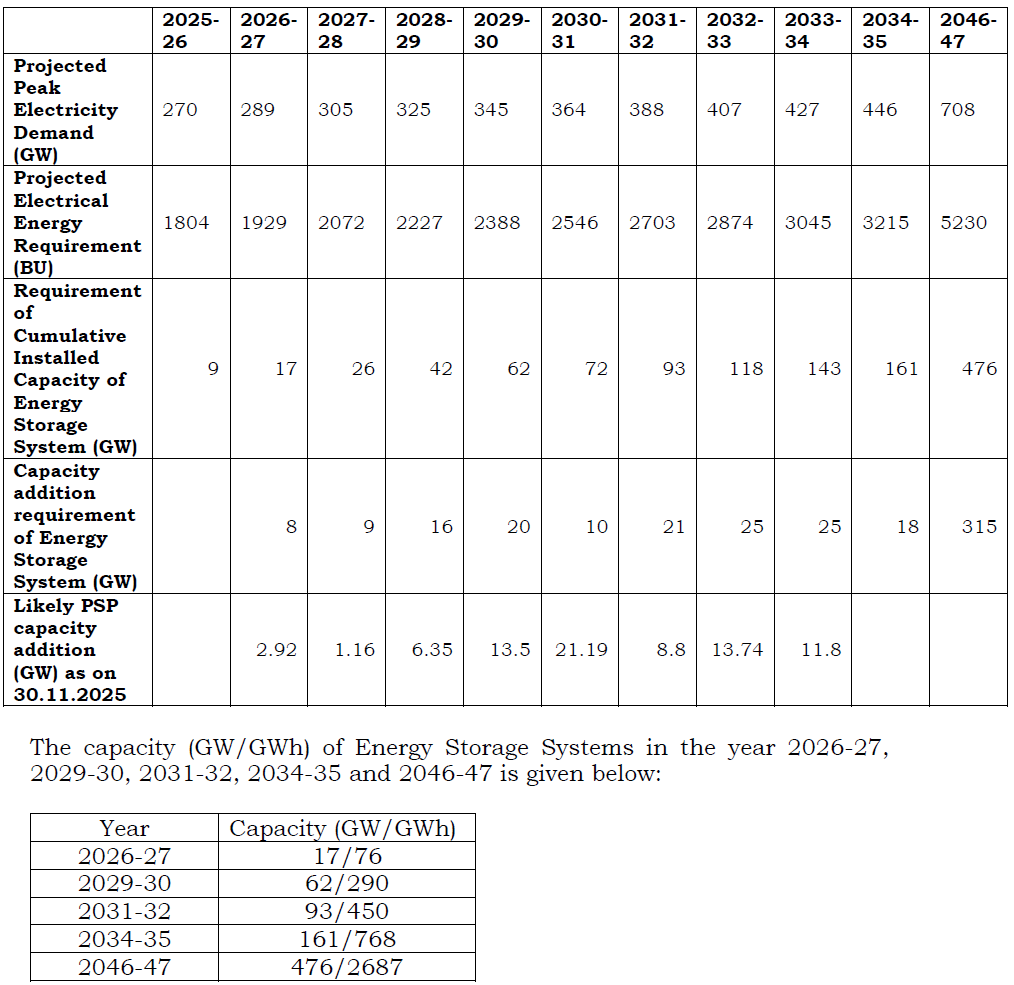
As per CEA`s Studies, the requirement of Storage Capacity on all-India basis is projected to increase to 62 GW by 2029-30; 161 GW by 2034-35 and 476 GW by 2046-47. Year-wise details are as per Table below:
Based on Resource Adequacy Plan for States till 2034-35, required installed capacity of Energy storage systems in major states is as per Table below:

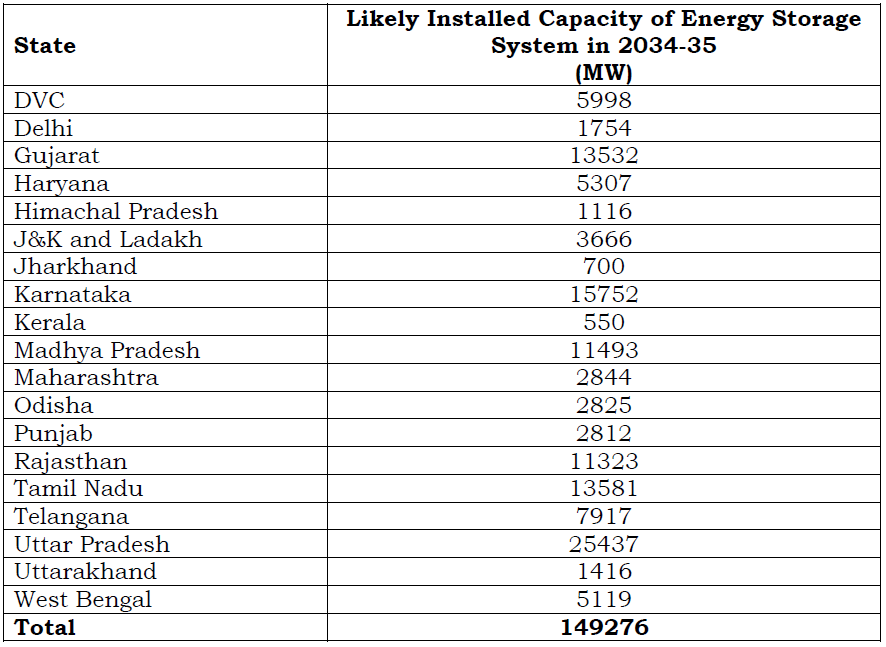
The storage requirement can be met either through Hydro PSP or BESS or a combination of both. BESS is suitable for short duration storage and PSPs are suitable for long duration storage. Based on the studies carried out by CEA, it has been found that long term storage (6 hrs) is required for integrating higher quantum of RE beyond 2030
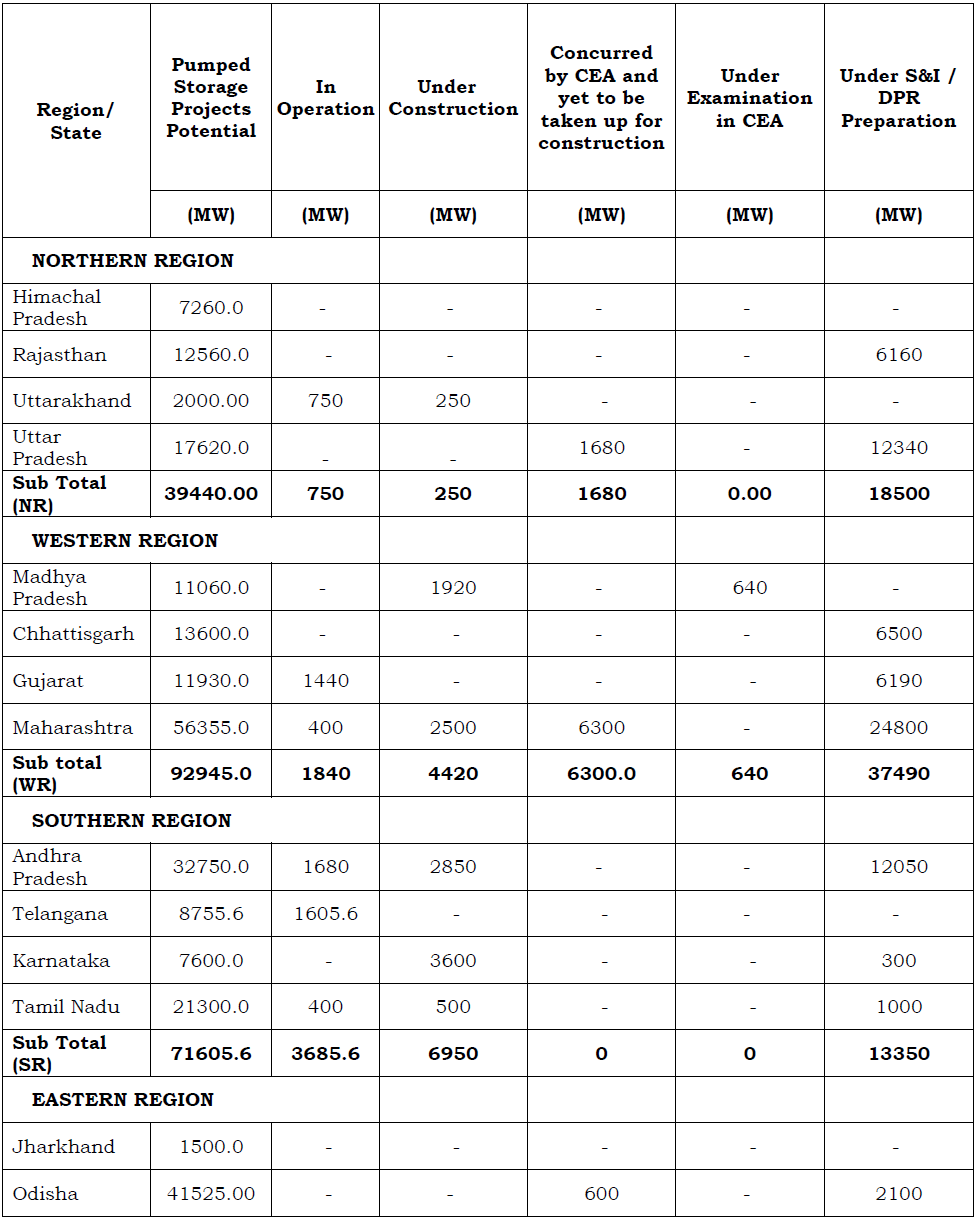
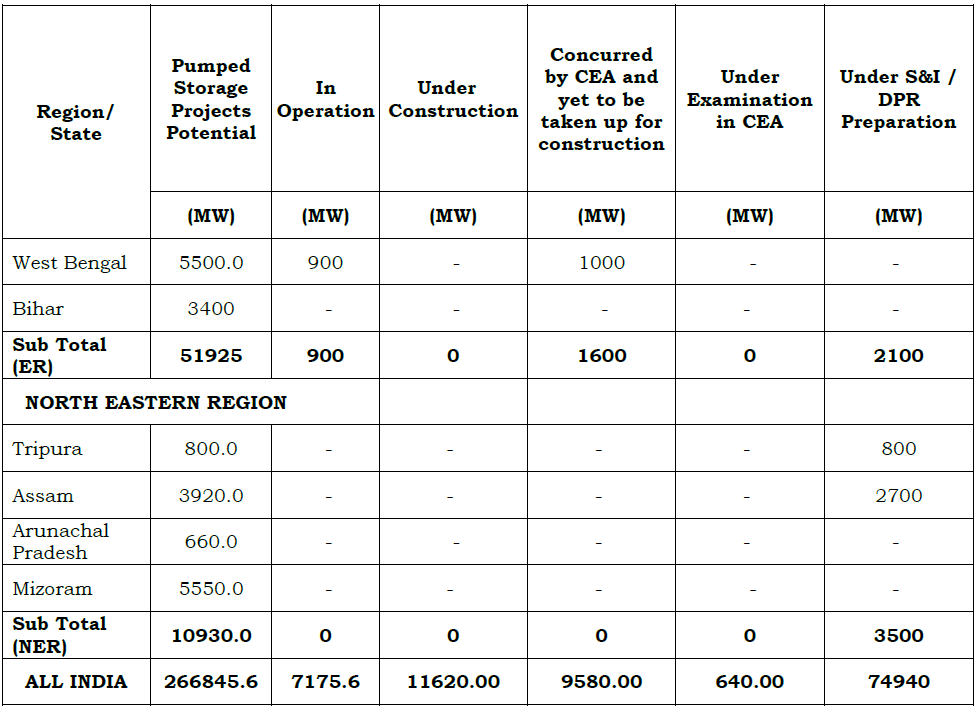
Summary of Region-wise and State-wise Pumped Storage Project development in the country is as given in Table below:
As per information available with CEA, Pumped Storage Projects with an aggregate capacity of 100,810 MW have been envisaged to be commissioned by the year 2035-36 including 11620 MW of PSP under construction. Summary of year wise capacity addition is as given in Table below:
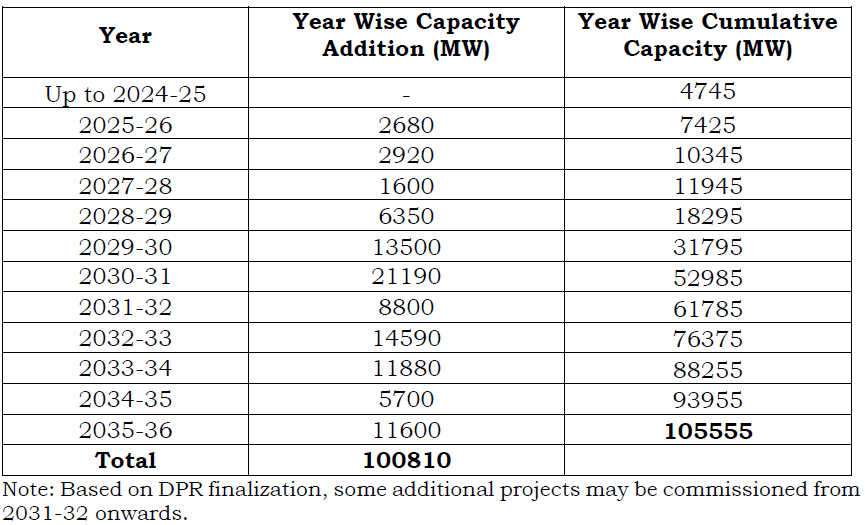
Based on projections by CEA, a large programme of PSP installation has been planned up to 2035-36 to meet the growing need for long-duration energy storage. As a result, the total investment required for upcoming PSPs is estimated at around Rs 5.8 lakh crore, calculated at an average cost of Rs 6 crore per MW. The investment requirement is spread over multiple years for each project, typically with 20% expenditure in the first year, 30% in the second year, 30% in the third year, and the remaining 20% in the fourth year
Ministry of Power has notified Guidelines to promote development of Pumped Storage Projects in the country on 10th April, 2023. Keeping in view the immense utility of the PSPs in grid stabilization as well as meeting the peaking power demand, guidelines have been formulated to promote PSPs and set the direction of its development. The Ministry seeks to promote the development of PSPs across the country with proactive support of the State Governments. The guidelines include:
- Allotment of project sites;
- On nomination basis to CPSUs and State PSUs
- Allotment through competitive bidding
- Allotment through TBCB
- Self-identified off-stream Pumped Storage Projects
- Developers shall begin construction within a period of 2 years from the date of allotment of the project, failing which, allotment of the project site shall be cancelled by the State;
- Exemption from Free Power obligation;
- Avoidance of double taxation on power supplied by PSPs;
- Notification of benchmark cost of storage by Central Government for investment decisions of CPSUs for PSPs considering 6-8 hours of operation;
- PSPs to be allowed to participate in the high price segment of the day ahead market (HP-DAM);
- Monetization of Ancillary services
CEA Suggestion: In case of power generated by “on river projects in Monsoon in “Turbine” Mode, 80% energy is to be given at secondary energy rate, while 20% energy can be sold at market rate by developer. In order to improve the viability of Project, it is suggested that 80% of energy in “Turbine Mode” shall be made available @ 75% of MCP (Market Clearing Price) for the financial year to Home State
The hydro projects and PSPs are often taken up in remote areas which have infrastructure deficits. The infrastructure created for hydropower / PSP enables further development of the area as the same is available for reuse for other purposes. Given the same, the Central Government is providing budgetary support for funding the enabling infrastructure of hydropower projects. This scheme also covers PSPs. The grant for enabling infrastructure is for the creation of infrastructure facilities that have alternate developmental value
The MoP vide OM dated 30.09.2024 has approved the modified scheme of budgetary support towards enabling infrastructure of hydroelectric projects wherein the ambit of enabling infrastructure has been widened to include the following apart from Roads/ Bridges
- Railway Sidings
- Transmission System upto pooling point including upgradation of pooling station
- Communication infrastructure
- Rope ways
Further, the limits for the scheme were revised as follows;
- Capped at Rs. 1.0 crore per MW for projects upto 200 MW;
- Capped at Rs. 200 crores + Rs. 0.75 crore per MW exceeding 200 MW, for projects above 200 MW
The scheme has a total outlay of Rs.12,461 crore for cumulative generation capacity of about 31GW (including 15 GW capacity of PSPs) to be implemented from FY 2024-25 to FY 2031-32
MoP vide order dated 10.06.2025 has extended the 100% waiver of ISTS charges for PSPs for which construction work is awarded on or before 30.06.2028. There will not be any ISTS charges waiver for PSPs, for which the construction work is awarded after 30.06.2028. Wavier shall be applicable for a period of 25 years from date of commissioning
Transmission system is required for providing connectivity to PSPs for power requirement during pumping and evacuation of power during generating mode. Concept to commissioning of transmission elements generally takes about three to four years; about two to three years for augmentation of transformers and about three to four years for new transmission lines or substations
In order to commission the transmission system in line with the implementation of PSPs, transmission planning is required to be done much in advance. This gives a visibility to PSP developers for evacuation of power from their PSP projects. Transmission system for 35.6 GW PSP has already been planned to be taken up by the year 2031-32. This plan has been included in the National Electricity Plan (Transmission) published in October, 2024
Pinnapuram Integrated Renewable Energy Project (IREP) has been developed as the World`s First & Largest Gigawatt Scale integrated project with Solar, Wind and Pumped Storage components at the same location that can supply Schedulable Power On Demand (SPOD) which is Dispatchable & Schedulable Renewable Energy to consumers across India.
All the RE Generation and PSP is connected at M/s Greenko’s Common Pooling Substation (CPSS) which is further connected to 400 KV Kurnool (New) substation through a Dedicated Transmission Line (DTL).
The capacity of PSP during generation is 1,680 MW and during pumping is 1,855 MW. In addition to PSP, the proposed Solar and wind capacities are 2,175 MW and 327.5 MW respectively including the generation capacity of M/s Arcelor Mittal which is also connected to M/s Greenko’s CPSS. The total co-located installed Generation/pumping capacity is more than 4,300 MW
By integrating the solar & wind along with large capacity storage, the transmission systems i.e. DTL and ISTS (CTU), has been planned in an optimal manner
In case these solar and wind generation sources were developed at different locations, it would have required a separate transmission system of 2,500 MW capacity and 1,855 MW (drawl requirement) capacity at two different locations and ISTS substations. Capacity utilisation factor (CUF) of these individual transmission systems would have been of the order of 25%-30% only, keeping in view the utilisation of transmission system for solar/wind would be only for 6-7 hours and transmission system for PSP would be only for 14-15 hours (both for Generation and pumping)
However, by co-locating both solar, wind and large-scale PSP, the requirement of combined transmission system gets reduced significantly and thus reduction of establishment of transmission infrastructure & better utilization of the existing grid. During daytime (Solar Hours), 1,855 MW power generated from solar and wind is utilised for charging of PSP and only balance power of around 400–500 MW during peak solar hours is injected into transmission system. Similarly, transmission system which would have been required for drawl of power from ISTS (CTU) substation have also reduced significantly due to local distribution of power to PSP from co-located Solar and wind generation
During evening time there will be requirement of transmission system for 1,680 MW injection from PSP and 300 MW from Wind. In this way the net transmission system developed for this co-located generation capacity is around 2,000 MW which otherwise would have been more than 4,300 MW if the solar and wind were installed at different locations
Further co-located development of Solar, Wind and PSP has resulted into local displacement of power from solar and wind to charging of PSP and the net power flow in the DTL and ISTS transmission system is reduced resulting into lower transmission losses. On account of lower transmission losses there will be significant saving during lifetime of project
Besides, co-located RE and PSP will go long way in balancing grid by neutralising the variable character of solar and wind generation resulting into large deviation. By integrating the variable RE generation with PSP deviation in scheduling can be minimised resulting into a stable power available to grid