
Conversion Factors: Primary Energy
Primary energy consumption is commonly presented in various units of measurements by different agencies
The units include Million Tons of Oil Equivalent (MTOE), Million tons of Coal Equivalent (MTCE), Exa Joules, Quadrillion BTU, TWh or million barrels of oil equivalent per day
To begin with, Table below captures From / To matrix of conversions, covering Peta Joules / Giga Calories / MTOE / MBtu / GWh
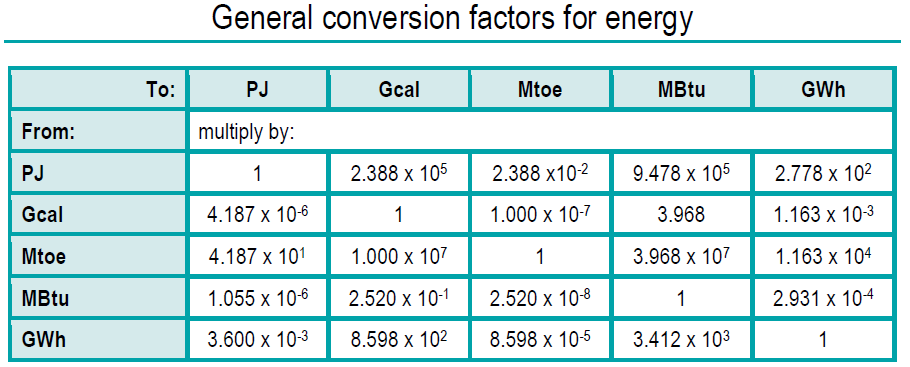
We will now explain the conversions, by anchoring the world primary energy consumption at a rounded off figure of ~15,000 MTOE, very close to the current consumption and probably the most common unit of measurement
IEA typically presents primary energy in Exa Joules
If we refer to the above From / To Matrix, 1 MTOE = 41.87 PJ, and since 1 exa = 1000 peta, hence :
15,000 MTOE = 15,000*41.87/1000 = ~628 Exa Joules, a number very close to the IEA number, keeping in mind that we have rounded off the MTOE number for ease of remembering
US EIA typically presents primary energy in quadrillion BTU.
If we refer to the above From / To Matrix,
1 MTOE = 3.968 × 10⁷ MBtu.
Since 1 MBtu = 106 BTU, this implies:
1 MTOE = 3.968 × 10¹³ BTU
As 1 quadrillion = 1015, converting global primary energy of ~15,000 MTOE gives:
15,000 × 3.968 × 1013 / 1015 ≈ 595 quadrillion BTU, very close to EIA number, keeping in mind that we have rounded off the starting MTOE number
There is also an alternative way of arriving at the same figure if one is more comfortable working in Exa Joules.
From the earlier conversion, global primary energy of ~15,000 MTOE corresponds to approximately 628 Exa Joules.
Since 1 Exa Joule = 1018 Joules, 1 quadrillion = 1015, and
1 BTU = 1,055 Joules, we obtain:
628 × 1018/ 1015/ 1,055 ≈ 595 quadrillion BTU
Both approaches converge to the same result, providing a useful consistency check across commonly used energy units.
Statistical agencies such as the United Nations Statistics Division (UNSD) use a ‘tonne of coal equivalent (TCE)’ as a benchmark energy unit. In UNSD’s standard conversion tables, one TCE is defined as ≈ 29.3076 GJ (derived from a reference calorific value of 7,000 kcal per kg of “standard coal”)
This implies: 1 TCE ≈ 0.0293076 TJ ≈ 29,307.6 MJ.
(The value of 29.3 GJ per tonne is itself derived from basic unit conversions, namely 1 cal=4.186 joules and 1 giga=10^6 as:
7,000 kcal/kg × 1,000 cal/kcal × 4.186 J/cal ≈ 29.3 MJ/kg, which corresponds to ≈ 29.3 GJ per tonne.)
Using this definition, and the standard conversion for oil equivalent (1 MTOE ≈ 41.868 PJ), we obtain: 1 MTOE ≈ 41.868 PJ ÷ 0.0293076 TJ per TCE ≈ 1.43 million TCE.
Anchoring to global primary energy of ~15,000 MTOE gives an approximate total of ~21,450 MTCE — broadly consistent with energy accounts expressed in coal equivalent units.
OPEC, as an oil-exporting producers’ group, commonly expresses total primary energy in terms of million barrels of oil equivalent per day (mboe/d). In this representation, all fuels — coal, natural gas, nuclear, hydro, and renewables — are first converted into their oil-equivalent energy content before being expressed as a daily flow.
This is a flow unit measured on a per-day basis, whereas all previous conversions discussed above were implicitly expressed in annual terms.
Accordingly, a 365-day year is assumed while converting annual MTOE figures into mboe/d (the exact conversion changes marginally in leap years).
There is no universal ton-to-barrel conversion factor for crude oil. Different agencies use different assumptions, with commonly used values ranging from about 7.22 to 7.6 barrels per tonne, depending on the reference crude quality.
Using a representative factor of 7.22 barrels per tonne, we obtain a convenient rule of thumb:
1 mboe/d ≈ 365 / 7.22 ≈ 50 million tonnes per annum of oil equivalent.
Applying this approximation, global primary energy consumption of around 15,000 MTOE corresponds to roughly 300 mboe/d. This is very close to the figures typically reported by OPEC for world primary energy when expressed in oil-equivalent terms, especially considering that the starting point of 15,000 MTOE itself is a rounded representation of global totals.
As the world progresses along its decarbonisation pathway, and as the share of electricity in final energy consumption continues to rise, primary energy is increasingly referenced in terawatt-hours (TWh) or petawatt-hours (PWh), particularly in electricity-centric energy system analyses.
Referring to the above From / To Matrix, 1 MTOE ≈ 1.163 × 10⁴ GWh. Since 1 TWh = 1,000 GWh, global primary energy consumption of around 15,000 MTOE corresponds to approximately 174,450 TWh, or 174.5 PWh after rounding.
Sanity check: Independent global energy statistics indicate that world primary energy consumption in the early 2020s, at around 14,800 MTOE, corresponds to just over 170 PWh per year. Using a rounded global total of 15,000 MTOE, our derived figure of approximately 174.5 PWh is therefore fully consistent with real-world global energy estimates.