
Conversion Factors: Volume
The table below captures standard From / To volume conversions covering US gallons, Imperial gallons, barrels, cubic feet, litres, and cubic metres.
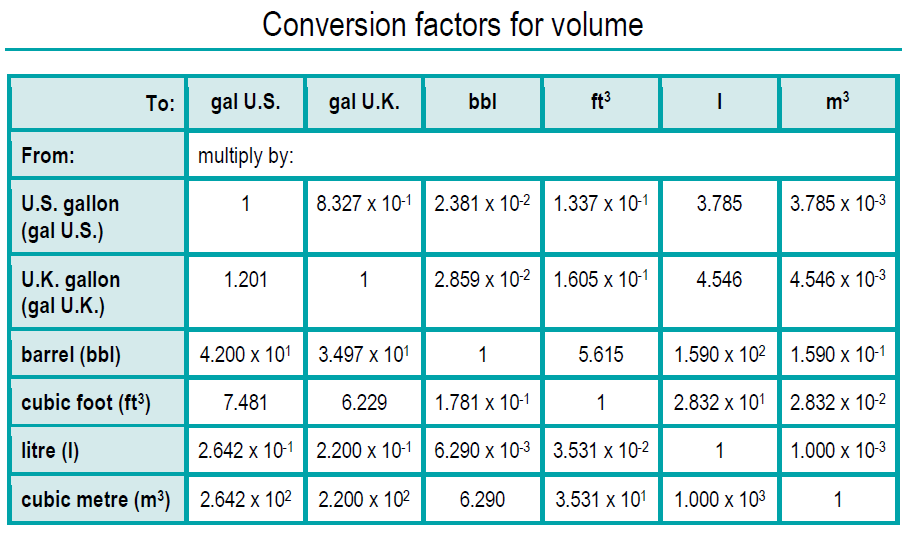
As discussed in the Natural Gas section, gas reserves are commonly reported either in metric units (billion or trillion cubic metres) or in US/imperial units (billion or trillion cubic feet).
A widely used identity is that 1 cubic metre ≈ 35.3 cubic feet. Using this, global gas reserves of approximately 208 TCM correspond to:
208 TCM × 35.3 ≈ 7,344 TCF.
Conversely, since 1 BCM ≈ 35.3 BCF, it follows that:
1 TCF = 1000 / 35.3 ≈ 28.3 BCM.
Referring to the From / To matrix, 1 barrel of oil equals approximately 159 litres.
While litres are identical across measurement systems, this is not the case for gallons.
One barrel of oil equals 42 US gallons (or approximately 34.97 Imperial gallons). Equivalently, 1 US gallon ≈ 3.785 litres, while 1 Imperial gallon ≈ 4.546 litres.
This distinction should always be kept in mind, as the term “gallon” is frequently used without explicitly specifying whether it refers to the US or Imperial system.
In the United States, gasoline prices are most commonly quoted in dollars per gallon, where the gallon implicitly refers to a US gallon.
For example, a price of $3 per gallon corresponds to:
$3 × 42 = $126 per barrel, and
$3 / 3.785 ≈ $0.79 per litre.
In contrast, gasoline prices in India are quoted in rupees per litre. For example, a retail price of Rs 105 per litre, using an exchange rate of $1 = Rs 90, translates to:
105 / 90 × 159 ≈ $185 per barrel.
This should not be surprising, as the retail price includes multiple components such as freight, dealer commission, central and state taxes, and other charges before the fuel reaches the dispensing unit.
More involved volume-to-energy and volume-to-mass conversions for gaseous fuels are addressed separately in the Natural Gas and LNG sections.