Crude Oil Characteristics
Crude oils are complex mixtures containing many different hydrocarbon compounds
Hydrocarbons containing up to four carbon atoms are usually gases, those with 5 to 19 carbon atoms are usually liquids, and those with 20 or more are solids
A typical crude oil contains about 84% carbon, 14% hydrogen, 1%-3% sulfur, and less than 1% each of nitrogen, oxygen, metals, and salts. Crude oils are generally classified as paraffinic, naphthenic, or aromatic, based on the predominant proportion of respective hydrocarbon molecules, and more commonly, in terms of API (American Petroleum Institute) gravity
- Paraffins are a series of hydrocarbon compounds that have the general formula CnH2n+2 and can be either straight chains (normal) or branched-chains (isomers) of carbon atoms
- Naphthenes are saturated hydrocarbon groupings with the general formula CnH2n, arranged in the form of closed rings (cyclic) and found in all fractions of crude oil except the very lightest. Single-ring naphthenes (mono-cyclo-paraffins) with five and six carbon atoms predominate, with two-ring naphthenes (di-cyclo-paraffins) found in the heavier ends of naphtha
- Aromatics are unsaturated ring-type (cyclic) compounds which react readily because they have carbon atoms that are deficient in hydrogen. All aromatics have at least one benzene ring (a single-ring compound characterized by three double bonds alternating with three single bonds between six carbon atoms) as part of their molecular structure. Naphthalenes are fused double-ring aromatic compounds. The most complex aromatics, poly-nuclears (three or more fused aromatic rings), are found in heavier fractions of crude oil
API / Sulphur
Lighter the crude, higher the API gravity, and Heavier the crude, lower is the API gravity
Crude oils that contain appreciable quantities of hydrogen sulphide or other reactive sulphur compounds are called "Sour" . Those with less sulphur are called "Sweet"
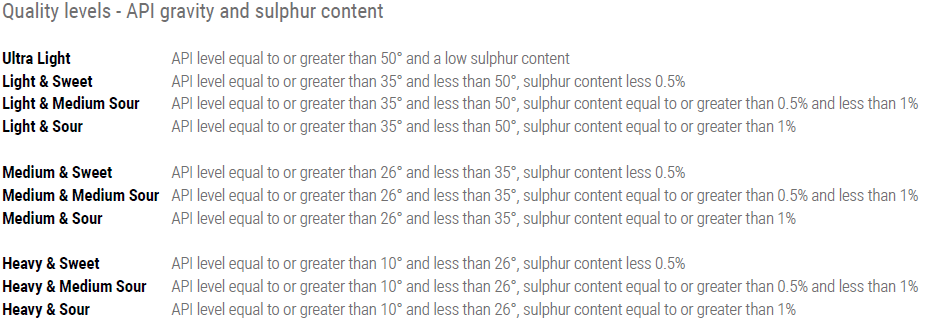
While there is no strict universal convention, we capture ENI`s definition of quality levels of crude oils in terms of API gravity and sulphur content (Source: ENI`s World Energy Review)
The quality of crude oil and other feedstocks dictates the level of processing and conversion necessary to achieve an optimal mix of finished products
Light sweet crude oils are more expensive than heavier and sourer crude oils because they require less treatment and produce a slate of products with greater percentage of value added, light refined petroleum products such as gasoline, aviation fuels and diesel
The heavier and sourer crude oils typically sell at a discount to the lighter and sweeter crude oils because they produce a greater percentage of lower value-added products with simple distillation and require additional processing to produce the higher value, light products
Refiners strive to process the optimal mix, or slate, of crude oils through their refineries, depending on each refinery’s conversion and treating capacity, the desired product output and the relative prices of available crude oils
World Crude Production by Quality
We again pick up the page from ENI`s World Energy Review as below, that captures world crude production by API / Sulphur content
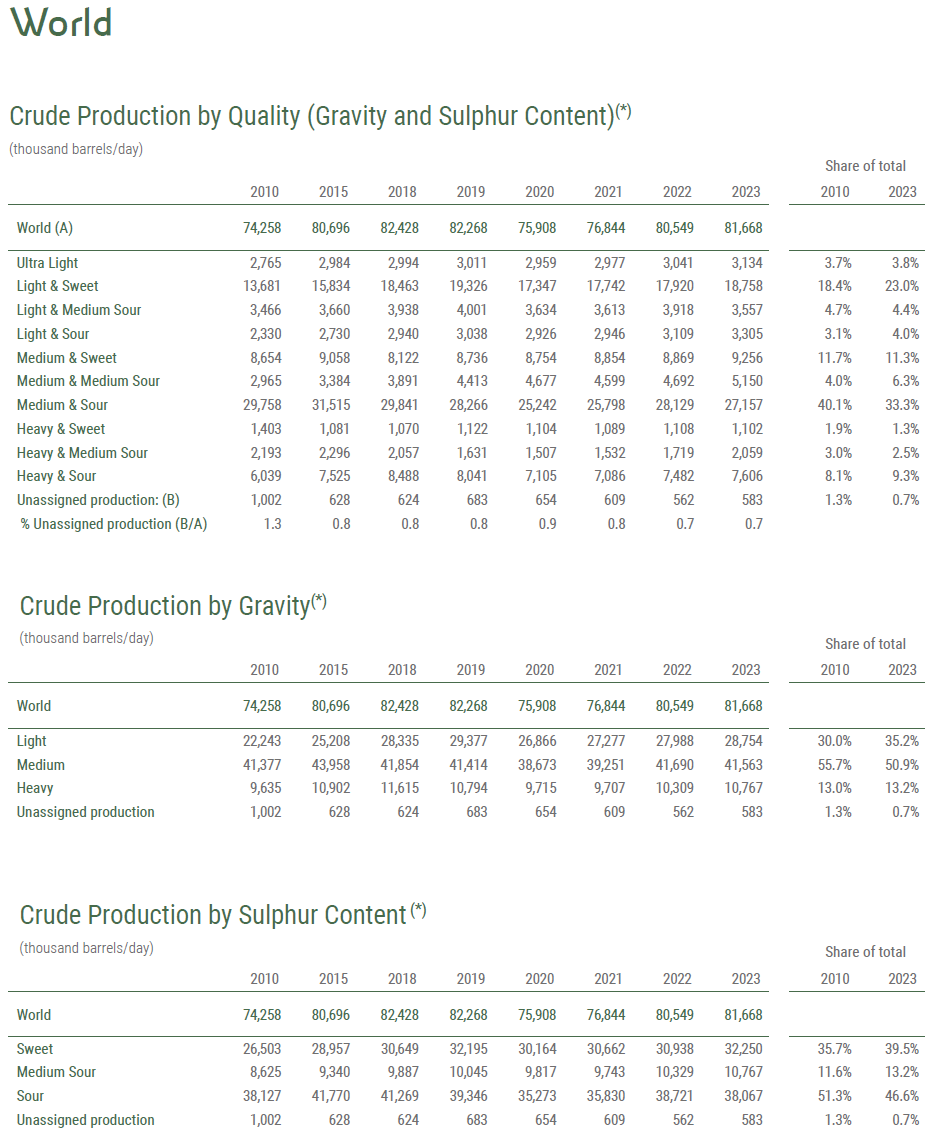
(*) Data source: Eni`s elaborations on IEA (2024) Monthly Oil Data Service data. All right reserved
Crude Oil Assays
Finally what matters to the refineries is the assay of the crude/s that will be processed. The Crude Oil Assay data helps refineries determine if a particular crude oil feedstock or a blend of crude oils is compatible for the particular crude oil refinery or not
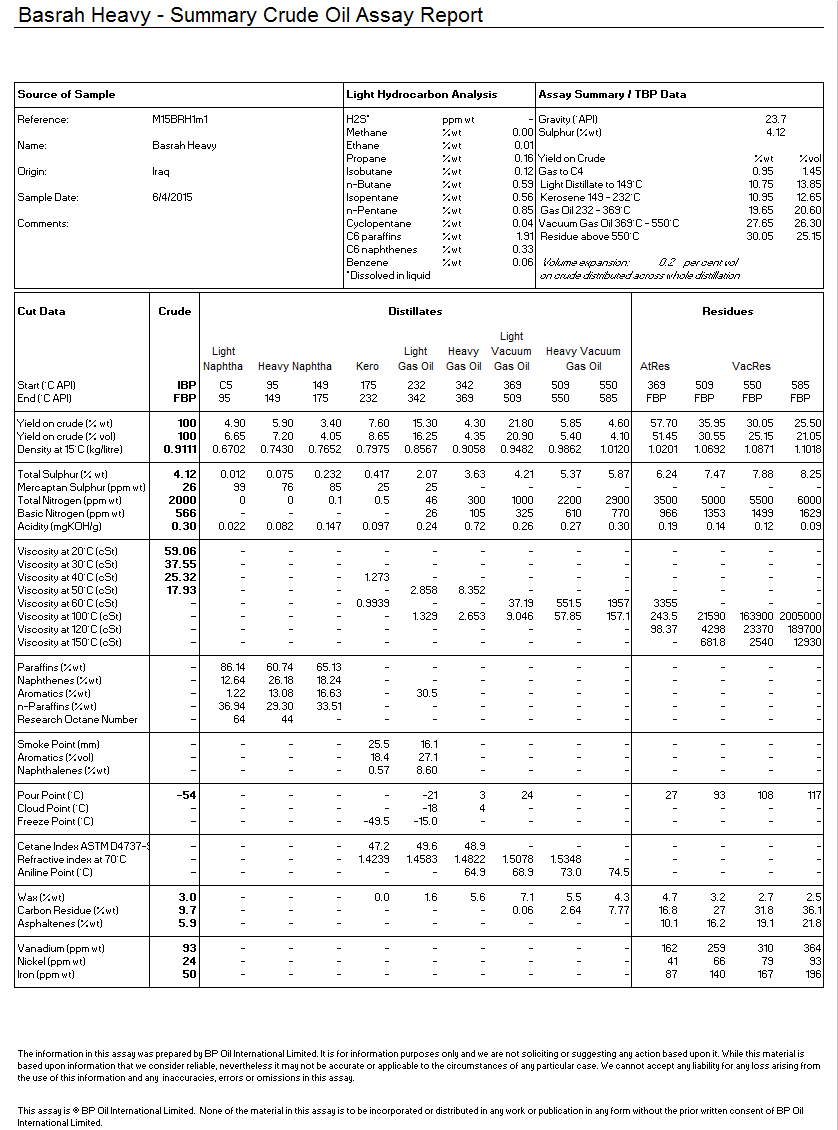
Companies like bp, Equinor, ExxonMobil publish assays of various crudes that they produce. We present assays of Brent (API 38 / Sulphur 0.424%) and Basrah Heavy (API 23.7 / Sulphur 4.12%) from bp's website to explain what all information is contained in the assay. While the former is Light / Sweet, the latter is Heavy / Sour
Before we discuss the assays, we reproduce the Disclaimer that bp has put on its website, and our disclaimer on a back to back basis is same
"The crude assays and other supplementary information in this website are provided for informational purposes only. The material is not advice on or a recommendation on any of the matters described. The material is not an offer or solicitation by or on behalf of bp p.l.c or any of its affiliates. bp makes no representations or warranties, express or implied, regarding the accuracy, adequacy, reasonableness or completeness of the information, assumptions or analysis contained in this presentation or in any supplemental materials. bp accepts no liability in connection with any of such information. "
In the right top summary section, bp provides yield on crude, both in wt% ad vol%. Thus in case of wt% for Brent, Gas to C4 accounts for 2.75%, Light Distillate to 149 Deg C accounts for 21.1%, Kerosene 149-232 Deg C accounts for 14.1%, Gasoil 232-369 Deg C accounts for 24.45%, Vacuum Gas Oil (VGO) 369-550 Deg C accounts for 25.6% and Residue above 550 Deg C accounts for 12%, with all adding up to 100%
The cut data provides more granular break up of the assay. These cuts are also popularly called as fractions. The assay sheet provides various properties of each of these fractions, like Yield / Density / Sulphur / Mercaptan / Total Nitrogen / Basic Nitrogen / Acidity / Viscosity at various temperatures / and several more. All these are critical in terms of ascertaining what crude blends a particular refinery can process to produce finished products that meet market specifications
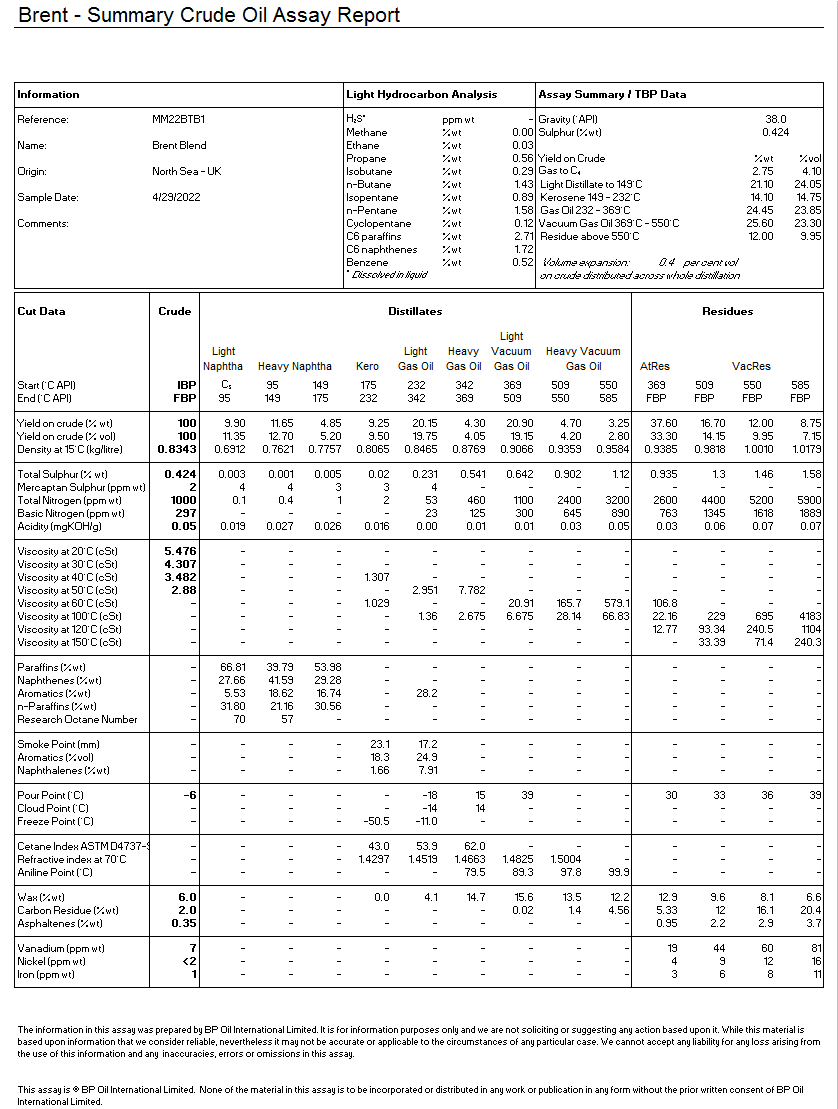
Properties of Basrah Heavy crude are significantly different compared to Brent, as captured in Table below. Thus, refinery configuration for processing Basrah Heavy will be significantly different from the one processing Brent